
Custom Card Printing Guides
Card Printing Thickness: GSM, PT, and Core Selection Guide
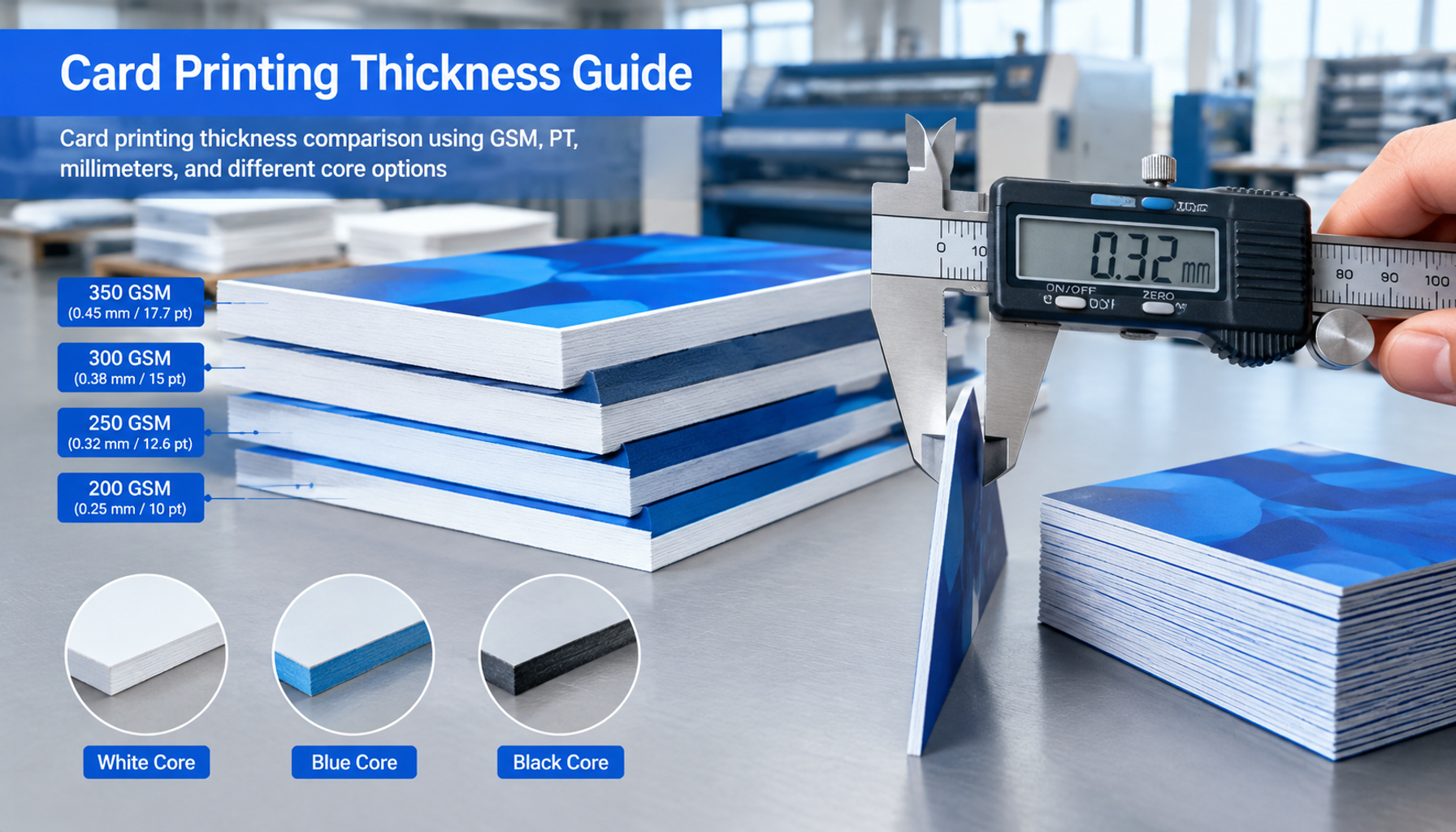
Table of Contents
- Choosing the Right Card Thickness
- GSM, PT, and Caliper Defined
- GSM, PT, and Millimeter Comparison
- Card Core Options
- Thickness by Card Application
- Thickness Trade-Offs
- How Finishes Affect Thickness
- How to Specify Card Printing Thickness
- MOQ, Sampling, and Production
- Quality Control and Tolerances
- Packaging and Shipping Effects
- Key Takeaways
- Conclusion
A practical B2B guide to comparing GSM, PT, millimeters, paperboard cores, and plastic constructions when specifying custom cards.
Choosing the Right Card Thickness
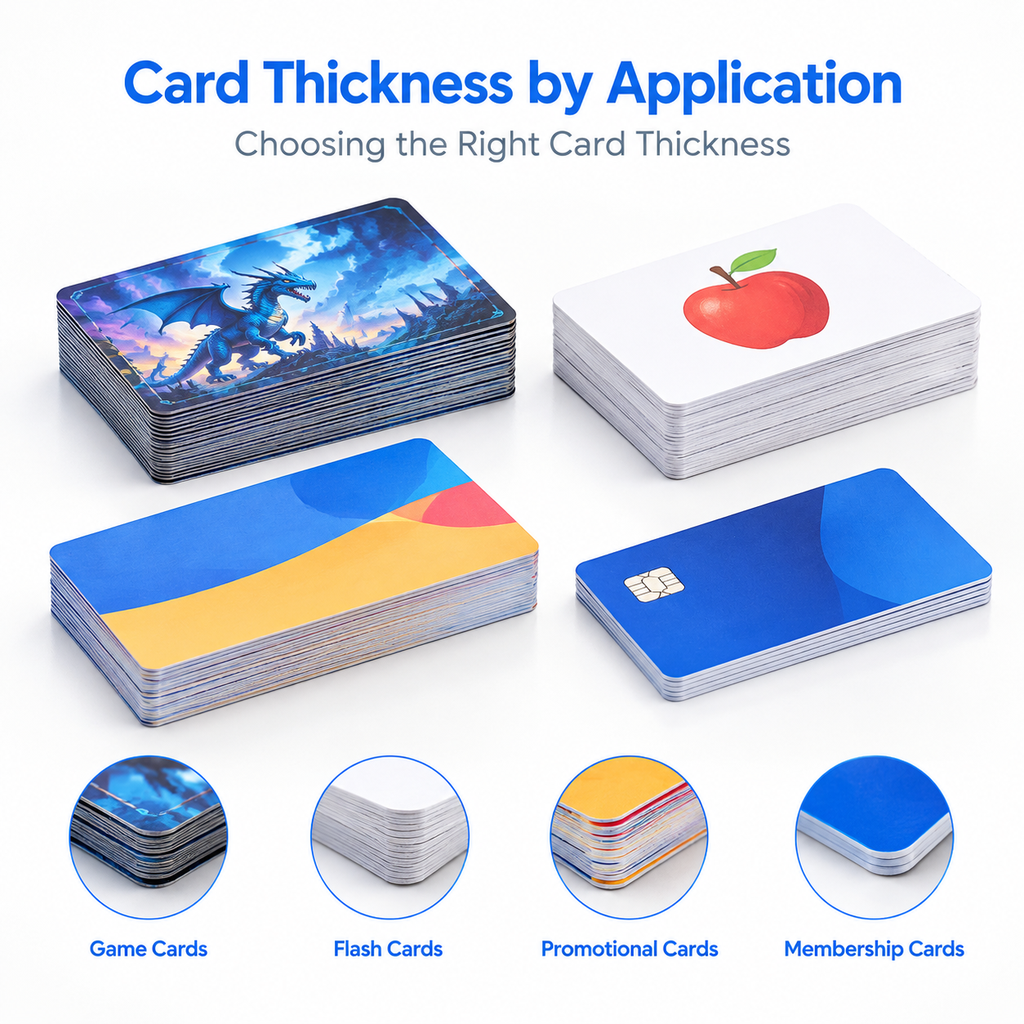
The right card printing thickness depends on how the card will be handled, shuffled, stored, mailed, scanned, or displayed. There is no single thickness that is best for every project. A frequently shuffled game deck usually needs a flexible, resilient stock, while a flash card may benefit from greater stiffness. A membership card intended for long-term wallet use may require a layered plastic construction instead of paperboard.
For reliable sourcing, specify the material, nominal GSM, measured thickness in millimeters or PT, core type, surface finish, card dimensions, deck count, and acceptable production tolerance. Do not approve a stock from GSM alone because two papers with the same basis weight can have different thickness, stiffness, opacity, and handling characteristics.
Specifications, MOQ, price, and lead time depend on the card type, material, quantity, printing process, finish, packaging, and inspection requirements.
GSM, PT, and Caliper Defined
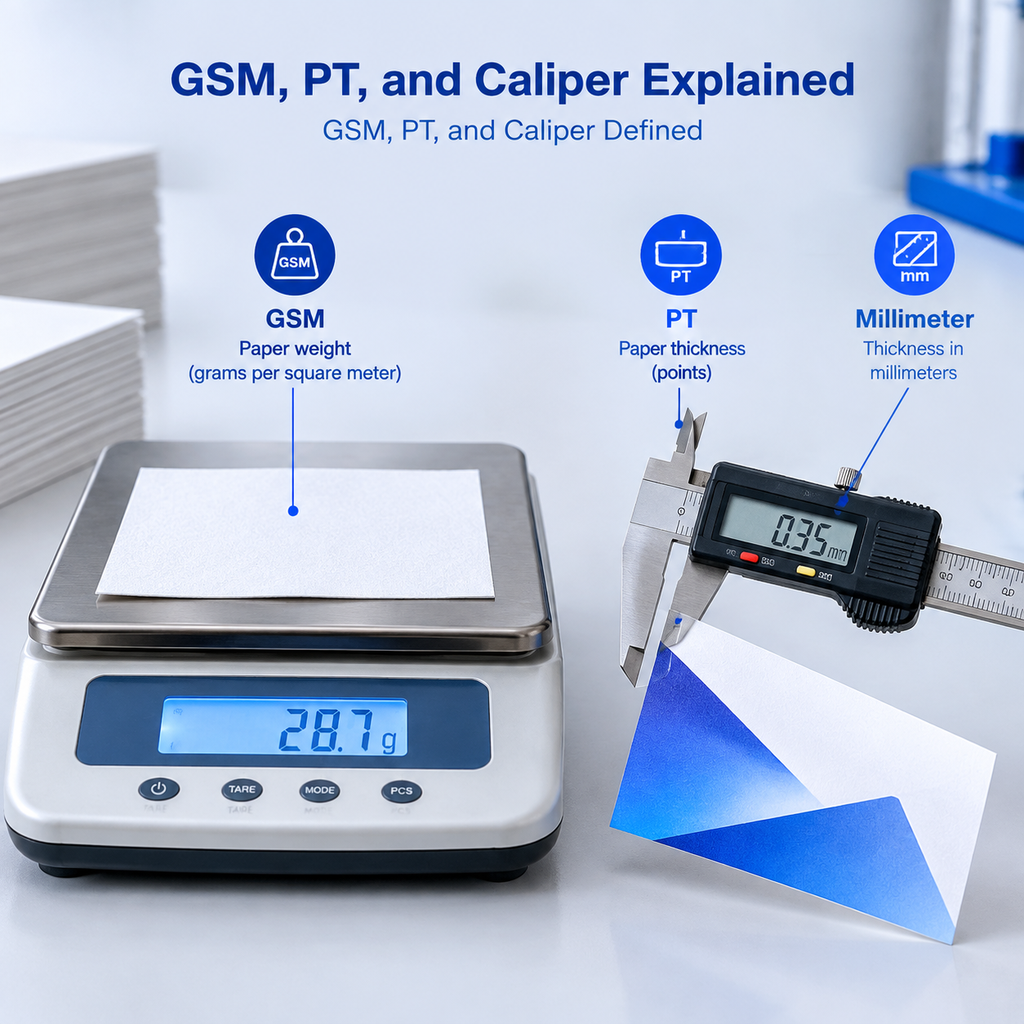
GSM means grams per square meter. It measures the basis weight of paper rather than its physical thickness. Higher GSM often indicates a heavier sheet, but paper density and construction determine how thick the sheet actually is.
PT, also called point, is a thickness measurement commonly used in North America. One point equals 0.001 inch. For example, 14 PT means 0.014 inch, or approximately 0.356 mm.
Caliper is the measured thickness of a sheet or finished card. Manufacturers may state it in millimeters, microns, inches, or PT. One millimeter equals 1,000 microns, and one PT equals 0.0254 mm.
Core refers to the internal layer or structure of a card stock. Its color and composition can influence opacity, snap, stiffness, durability, and whether light or back-side artwork is visible through the card.
Finished thickness is the caliper after printing, coating, lamination, and any other applied layers. This is often more useful to a buyer than the nominal thickness of the unprinted base stock.
GSM, PT, and Millimeter Comparison
GSM and thickness units describe different properties, so there is no universal GSM-to-PT conversion. The following table shows how each measurement should be used in a purchase specification.
| Measurement | What it describes | Useful for | Important limitation |
|---|---|---|---|
| GSM | Weight per square meter | Comparing paper grades and estimating material weight | Does not directly establish thickness or stiffness |
| PT | Thickness in thousandths of an inch | North American packaging and card specifications | May refer to base stock or finished card; confirm which |
| Millimeters | Metric physical thickness | Factory drawings, caliper checks, box dimensions, and stack height | Must include an agreed measurement method and tolerance |
| Microns | Metric thickness where 1,000 microns equal 1 mm | Thin films, coatings, laminates, and plastic layers | Individual layer thickness is not necessarily finished card thickness |
Direct mathematical conversion is possible between PT and millimeters: multiply PT by 0.0254 to obtain millimeters. It is not possible to convert GSM accurately into PT without knowing the stock’s density and construction. Always request the supplier’s measured caliper or test a physical sample.
Card Core Options and Their Practical Effects
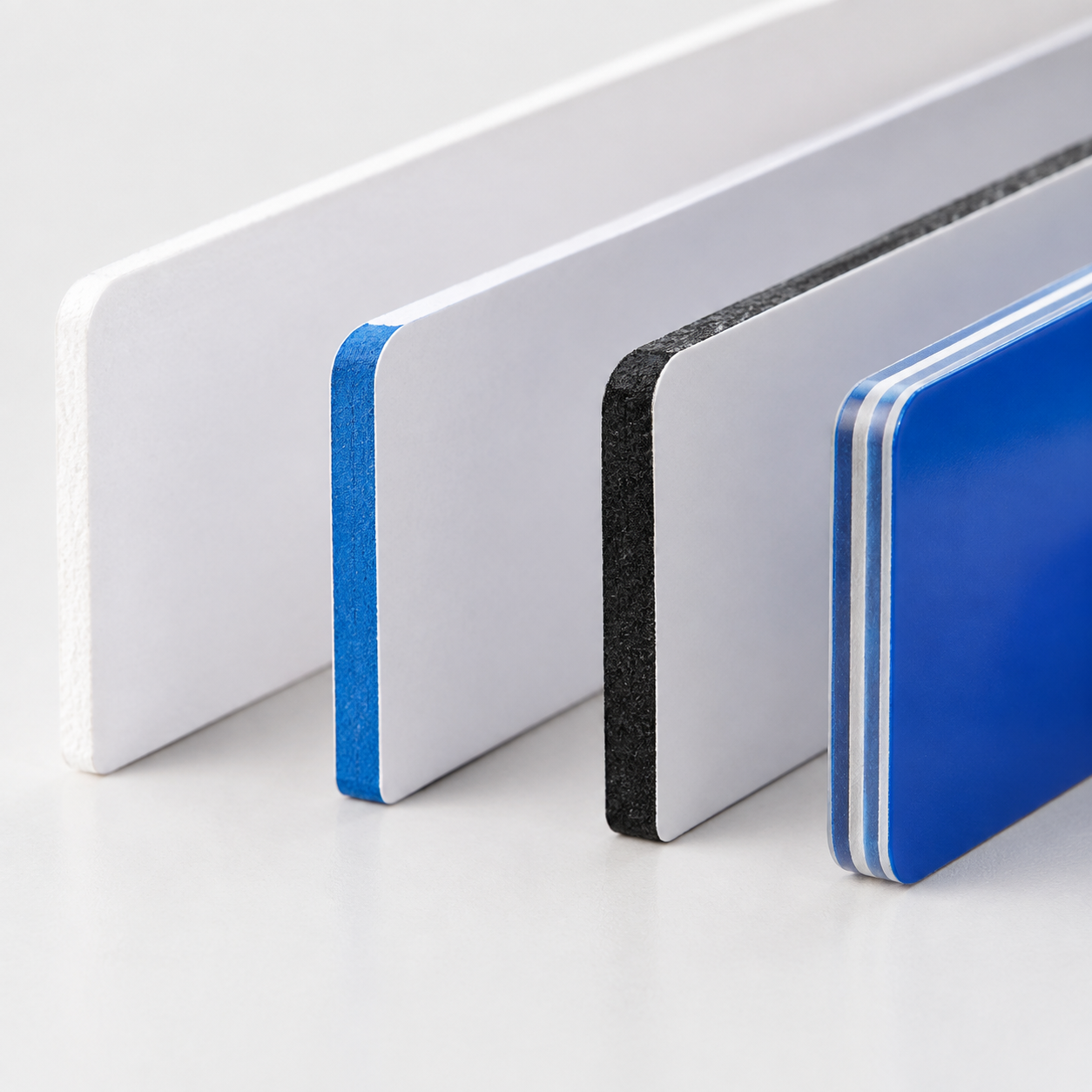
The core is not merely a color label. Core construction can affect opacity, bending response, recovery after shuffling, edge appearance, and cost. Available names and constructions vary by paper mill and factory, so buyers should approve a real stock rather than relying only on a generic description.
Black core paper
A black internal layer helps block light transmission and reduces the chance of artwork showing through from the opposite side. It is commonly considered for playing cards, game cards, and other hidden-information decks. Performance still depends on the complete paper structure, coating, grain direction, and finish.
Blue core paper
Blue core stock is another option for opaque, shuffle-oriented cards. It may provide a different balance of cost, stiffness, and handling depending on the exact mill grade. The term does not guarantee a universal caliper or quality level.
White or standard paperboard core
White-core or standard paperboard can suit flash cards, promotional cards, greeting inserts, and products where complete light blocking is not essential. Cut edges generally appear lighter, but opacity should be checked when artwork uses strong contrast.
Layered plastic construction
PVC and other plastic cards are often built from printable sheets and overlay layers fused into a finished card. They resist moisture and frequent handling but differ from paper cards in feel, recyclability considerations, printing process, personalization options, and cost structure. Buyers comparing paper and plastic can review this guide to paper, PVC, and smart membership card options.
Typical Thickness Priorities by Card Application
This application table is a starting point, not a fixed product specification. Card dimensions, number of cards, user age, handling frequency, finish, packaging, and target market must be considered together.
| Card product | Main thickness priority | Common material direction | What to verify in a sample |
|---|---|---|---|
| Playing or game cards | Flexibility, snap, opacity, and consistent shuffling | Coated paper with an opaque core | Shuffle feel, light blocking, edge quality, and deck stack height |
| Tarot or oracle cards | Premium hand feel balanced with manageable deck thickness | Coated paperboard with selected core and finish | Handling of larger cards, bowing, finish, and fit inside the box |
| Flash and educational cards | Stiffness, readability, and resistance to classroom handling | Paperboard or synthetic material based on use | Corner safety, wipe resistance, rigidity, and pack weight |
| Promotional cards | Cost-efficient mailing or distribution | Standard coated or uncoated paperboard | Print appearance, mailing weight, and finishing compatibility |
| Membership or loyalty cards | Wallet durability and compatibility with variable data or codes | Paper, synthetic, or layered PVC | Scanning, personalization, abrasion resistance, and final caliper |
For deck-specific decisions, see the detailed custom game card printing specification guide. Educational publishers can also compare requirements in the custom flash card production guide.
Thickness Trade-Offs B2B Buyers Should Evaluate
A thicker card can feel substantial, but thicker is not automatically better. The specification affects manufacturing, usability, packaging, and freight.
- Handling: Very stiff cards may be difficult to riffle shuffle, especially in large decks or larger formats.
- Durability: Durability depends on fibers, core structure, coating, lamination, edge quality, and use—not thickness alone.
- Opacity: A thinner opaque-core stock may hide back-side artwork better than a thicker low-opacity board.
- Deck height: A small increase per card becomes significant across a 50-, 80-, or 100-card deck.
- Packaging: Greater stack height requires a deeper tuck box, tray, rigid box, or magnetic case.
- Freight: Heavier or larger packed cartons can affect shipping cost and pallet configuration.
- Finishing: Thick or highly rigid stock may require adjusted die-cutting, scoring, collation, or wrapping settings.
The practical goal is the lightest and thinnest construction that still meets handling, opacity, durability, and brand-positioning requirements—or the most substantial construction that remains functional and economical.
How Coatings and Laminates Affect Finished Thickness
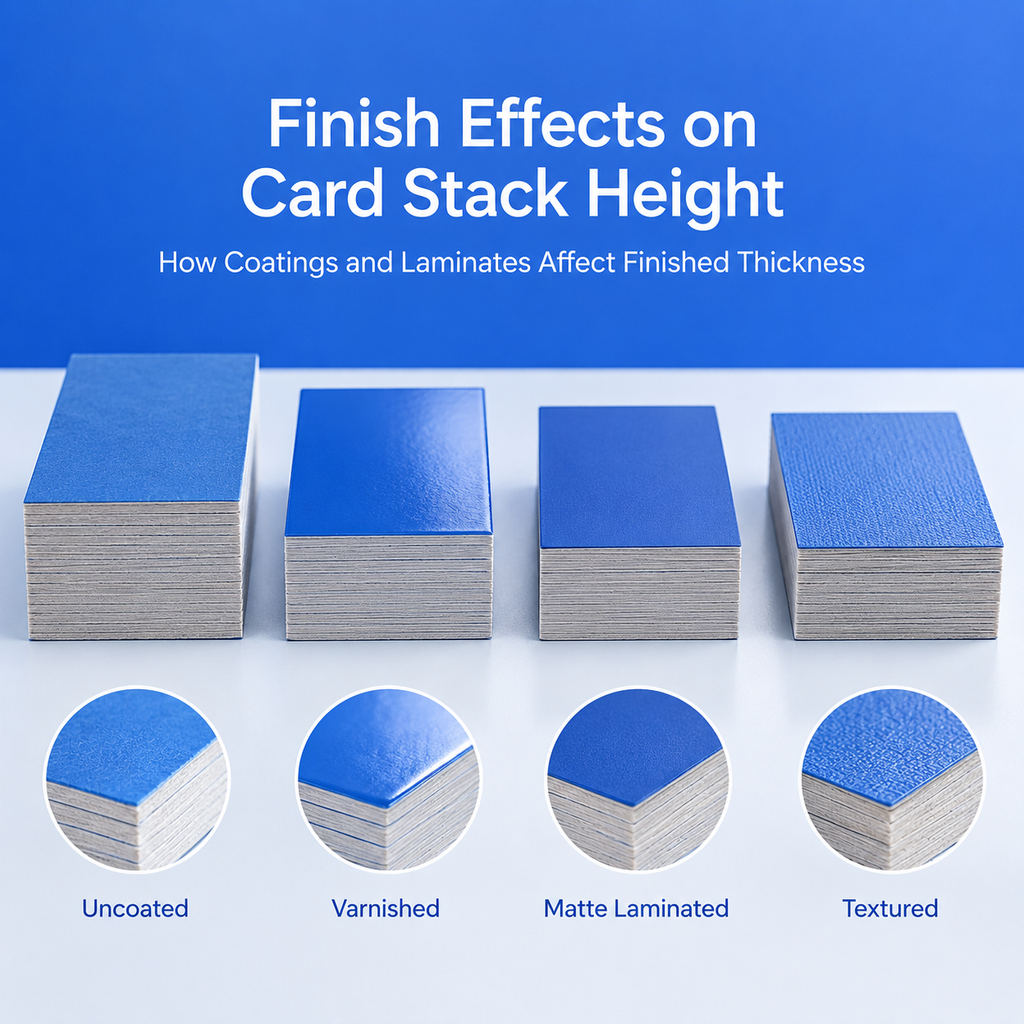
Surface treatment can change the measured caliper and, more importantly, the way a card feels and performs. Aqueous or varnish coatings generally add less bulk than laminated films, although the actual construction must be confirmed. Film lamination can improve surface protection but may make a deck stiffer and increase stack height.
Embossed textures influence friction and handling. Linen-style patterns, matte surfaces, gloss surfaces, soft-touch films, foil stamping, spot effects, and edge treatments each introduce different production considerations. Some decorative finishes cover only selected areas and do not produce a uniform increase in thickness.
Measure and approve the complete printed and finished sample. Comparing an unfinished paper swatch with a laminated production card can lead to inaccurate conclusions. Larger cards also feel more flexible than smaller cards made from the same stock because their dimensions change leverage during handling. Buyers planning oversized spiritual decks can review the relationship among stock, finish, and packaging in this custom tarot card specification guide.
How to Specify Card Printing Thickness
Use a measurable, sample-based process instead of requesting only a general description such as “premium thick card.”
- Define the application. Explain whether the cards will be shuffled, mailed, displayed, written on, scanned, wiped, or carried in a wallet.
- State dimensions and card count. Width, height, corner radius, and cards per deck determine handling and total stack height.
- Select a material family. Choose coated paper, uncoated paperboard, synthetic material, or plastic according to use.
- Request GSM and measured caliper. For paper, include basis weight plus nominal thickness in PT or millimeters.
- Identify the core. State whether opacity or shuffle recovery is important and ask which mill grade is proposed.
- Add printing and finishes. Include ink coverage, coating, lamination, texture, foil, and other treatments.
- Calculate the deck stack. Multiply nominal finished card thickness by the card count, then allow practical clearance for packing and removal.
- Approve a representative sample. Test feel, flex, opacity, shuffle behavior, scratching, cutting, and packaging fit.
- Record the approved specification. Keep the material code, construction, finish, target caliper, tolerance, and approved sample reference with the purchase order.
MOQ, Sampling, and Bulk Production
Before ordering a custom production sample, ask for existing stock samples that demonstrate relevant materials, cores, and finishes. These samples help narrow the specification but may not reproduce your artwork, dimensions, ink coverage, or final packaging.
A custom sample is more suitable when thickness strongly affects shuffling, machine feeding, code scanning, box fit, or retail presentation. Digital samples may differ from offset bulk production in color, coating, or stock behavior, so the supplier should explain which characteristics the sample can reliably approve. A production-equivalent or pre-production sample may be appropriate for projects with strict functional requirements.
During bulk production, approved artwork, material references, imposed sheets, printing, surface treatment, cutting, sorting, collation, and packing must remain coordinated. Changing the stock or finish after box dimensions have been finalized can create fit problems.
MOQ depends on material availability, printing method, custom dimensions, finishing, packaging, and whether special stock must be purchased or produced. Price and lead time also depend on these project requirements. Buyers should request separate clarification for sampling quantity, production MOQ, sample method, material substitutions, and approval stages.
Quality Control for Thickness and Consistency
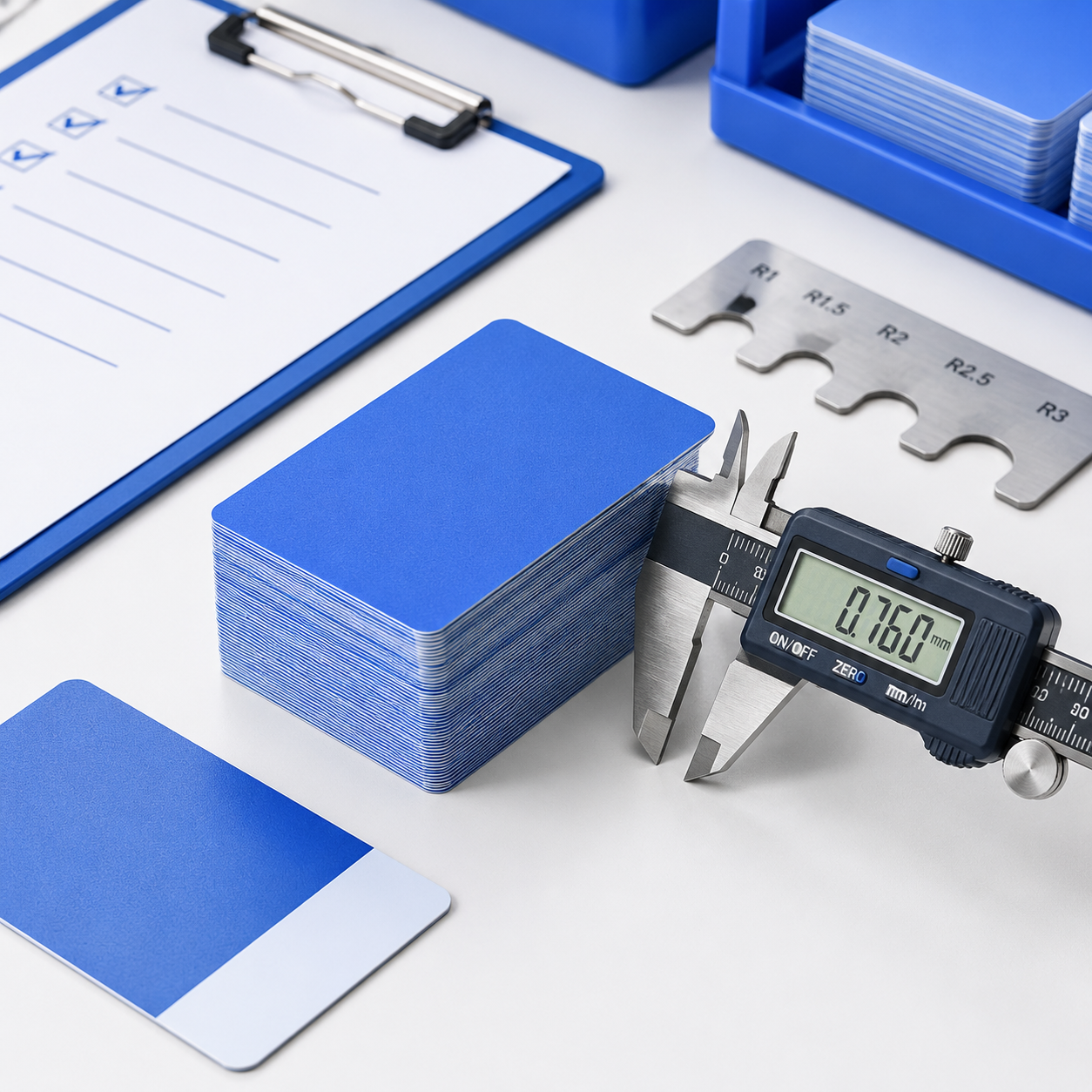
Paper and plastic manufacturing involve normal process variation, so a purchase specification should include an agreed target and tolerance rather than assuming every card will be mathematically identical. The measurement method should also be defined. A single-card reading, a compressed stack measurement, and an uncompressed stack measurement may produce different results.
YBJ Cards Printing applies seven quality-control checkpoints covering key stages from incoming requirements and materials through printing, finishing, cutting, assembly, packaging, and final inspection. For thickness-sensitive projects, practical checks can include:
- Confirming the material code and supplier specification against the approved sample;
- Measuring stock and finished-card caliper at agreed sampling points;
- Checking sheet flatness, grain direction, and unwanted bowing;
- Inspecting print color, coating coverage, lamination adhesion, and surface defects;
- Checking cutting dimensions, corner radius, edge condition, and deck collation;
- Comparing completed stack height with box or insert dimensions;
- Performing final count, packaging, carton, and shipping-mark inspections.
Buyers with a defined inspection standard should share it before quotation and sampling. This allows the factory to assess equipment, test methods, documentation, and acceptance criteria before production.
How Thickness Affects Packaging and Shipping
Packaging should be engineered around the finished production deck, not an estimated GSM conversion. The internal depth must accommodate card count, finished caliper, instructions, inserts, and a practical allowance for loading and removal. Excess clearance can make cards move during transit, while insufficient clearance can damage edges or prevent the box from closing correctly.
Tuck boxes are compact and efficient, while rigid boxes and magnetic cases can provide more structure and presentation space. Inserts, wells, ribbons, booklets, and wrapped card packs also change internal dimensions. Compare these custom card packaging options before locking the final dieline.
For export shipping, thicker cards can increase product weight, carton dimensions, and pallet volume. The factory should confirm cards per box, boxes per carton, carton protection, moisture protection where appropriate, gross weight, and shipping marks. Air, courier, sea, rail, and combined shipping methods involve different cost, speed, handling, and customs considerations. Shipping plans and delivery timing should be confirmed for the order destination and final packed specifications rather than estimated from the card alone.
Key Takeaways
- GSM measures paper weight; PT, millimeters, and microns measure physical thickness.
- There is no reliable universal conversion from GSM to PT because paper density and construction vary.
- Core selection affects opacity, stiffness, edge appearance, and handling.
- Evaluate finished caliper after coating or lamination, not only the base stock.
- Card count and finished thickness determine deck stack height and packaging depth.
- A physical sample is the most practical way to approve feel, flexibility, opacity, finish, and box fit.
- Specifications, MOQ, price, and lead time depend on the complete project requirements.
Conclusion: Approve Card Printing Thickness by Sample
A reliable card printing thickness specification combines basis weight, measured caliper, core construction, surface finish, card dimensions, deck count, packaging, and tolerance. GSM is useful for identifying paper weight, but it should not replace a physical thickness measurement. PT and millimeters are more direct for stack-height and packaging calculations.
For B2B production, compare suitable stock samples, test a finished custom sample when function or fit is critical, and document the approved material and measurement method before bulk manufacturing. This approach reduces ambiguity across artwork review, production, quality control, export packing, and worldwide shipping.
FAQ
What is the difference between GSM and PT for cards?
GSM measures paper weight in grams per square meter. PT measures physical thickness in thousandths of an inch. For example, 14 PT equals 0.014 inch, or approximately 0.356 mm. GSM and PT cannot be converted reliably without knowing the paper’s density and construction.
Can GSM be converted directly to card thickness?
No. Papers with the same GSM can have different calipers because their fibers, density, coatings, and internal structures differ. Request the stock’s nominal caliper in millimeters or PT and verify it with a sample.
Is black core card stock always thicker than blue core?
No. Core color does not establish thickness. Black and blue core stocks are available in different grades and constructions. Compare the exact material code, GSM, measured caliper, opacity, stiffness, finish, and sample performance.
Should card thickness be measured before or after lamination?
When deck height, handling, or packaging fit matters, evaluate finished thickness after printing, coating, or lamination. The base stock measurement remains useful for material control, but the finished caliper represents the product the buyer receives.
How does card thickness affect MOQ, price, and lead time?
Thickness may affect material availability, stock purchasing, printing and cutting settings, packaging dimensions, and shipping weight. MOQ, price, sampling method, and lead time depend on the complete project, including card type, size, quantity, core, finish, packaging, and inspection requirements.
Ready to Start Your Custom Card Project?
Send us your card type, size, material, quantity, finish, and packaging requirements. Our factory team will recommend suitable thickness, core, production, and sampling options and prepare a tailored quote.
“A physical material sample is the clearest way to confirm thickness, handling, and packaging fit before bulk production.”
Keep Reading
Related Articles
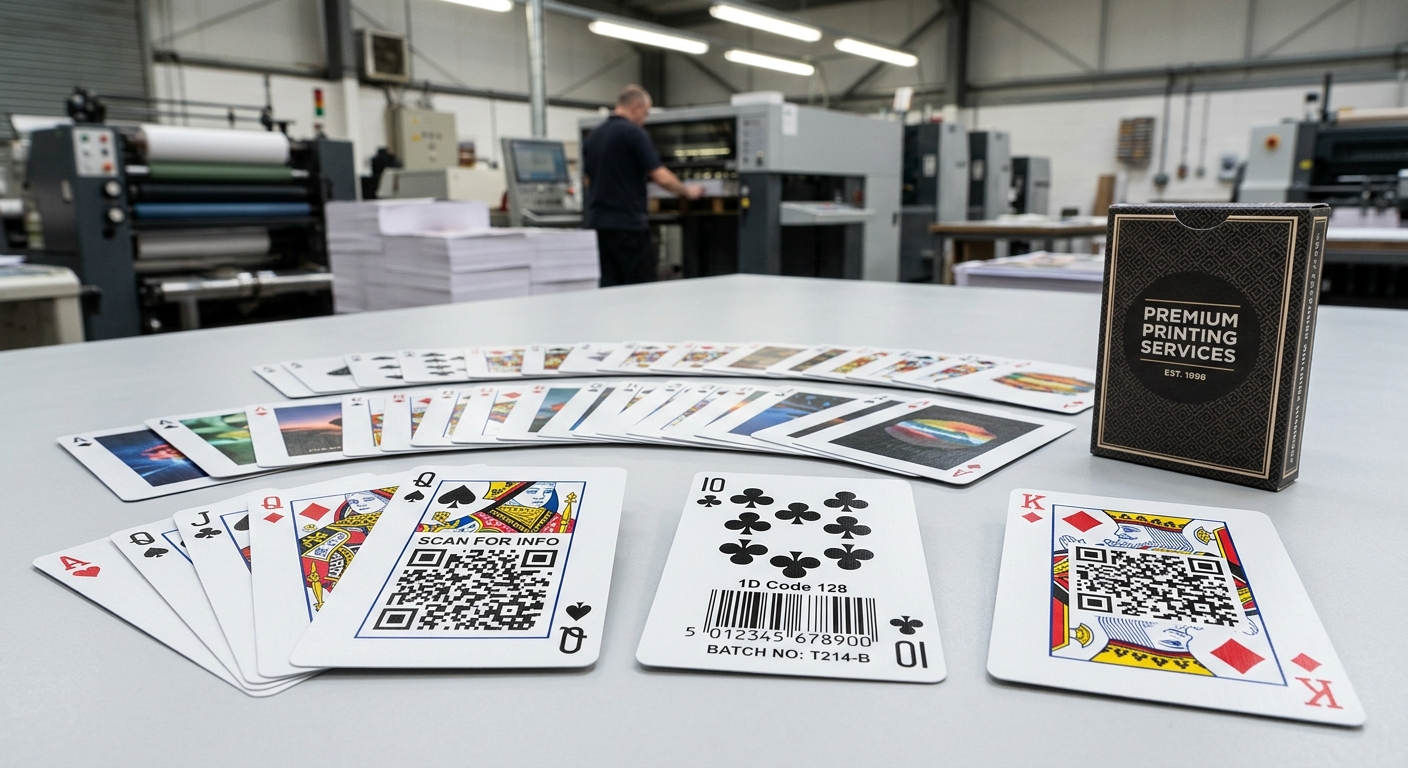
How to Print Custom Cards with QR Codes and Barcodes in a Deck
Printing scannable codes on a custom card deck requires coordination between code generation, database management, artwork preparation, print production, finishing, and scan testing. This practical guide explains how B2B buyers can prepare reliable QR codes and barcodes for static or variable-data card decks.
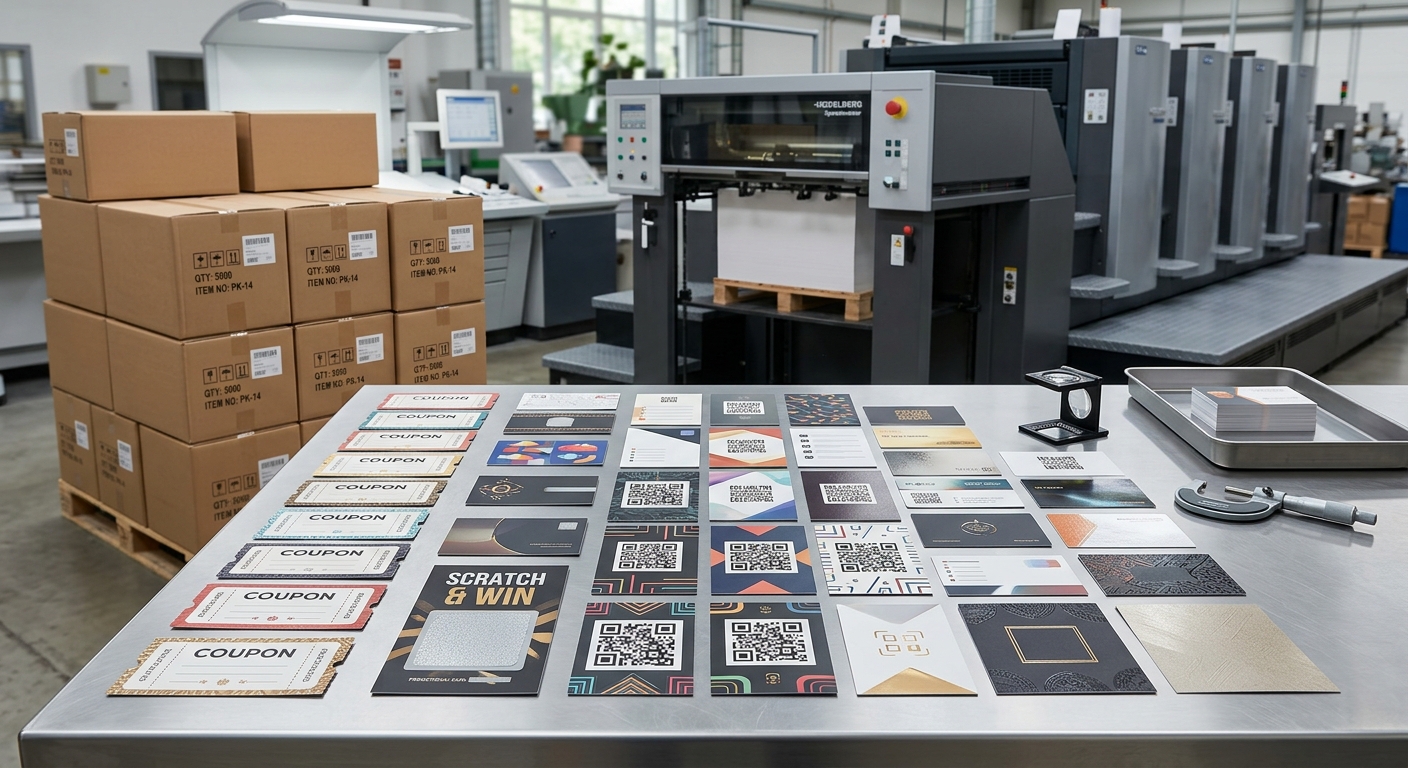
Custom Promotional Card Printing for Marketing Campaigns: Formats and Production Tips
Custom promotional card printing helps brands deliver compact, measurable marketing materials for launches, retail promotions, events, loyalty programs, and direct-mail campaigns. The best result depends on matching the card format, material, finish, artwork, quantity, and packaging to the campaign objective.

Custom Greeting Card Printing Wholesale: Sizes, Finishes, and Packaging Guide
Custom greeting card printing wholesale requires coordinated decisions about card size, paper stock, folding, finishes, envelopes, packaging, and shipping. This guide helps publishers, retailers, agencies, and gift brands prepare a practical production brief and reduce avoidable sampling or packing issues.
Fast Quote Support
Ready to Start Your Custom Card Project?
Send us your product type, size, material, quantity, and packaging requirements. Our team will reply within 24 hours with production suggestions, sampling options, and a competitive quote. No setup fees.