
Production & Quality
Card Deck Collation: Prevent Missing and Duplicate Cards

Table of Contents
- What Is Card Deck Collation?
- Build a Master Card List
- Define Card Sequencing and Deck Assembly Rules
- Separate Language Editions and Product Versions
- Compare Card Count and Identity Checks
- Match Assembly Requirements to the Deck Type
- Approve Samples Before Bulk Production
- Set Inspection and Rework Rules
- Use a Packing Checklist Through Shipping
- Key Takeaways for Buyers
- Conclusion: Make Correct Contents Measurable
A complete deck requires more than the correct card count. Learn how to specify card identities, intentional duplicates, sequence rules, language editions, and packing checks before bulk production.
What Is Card Deck Collation?
To prevent missing and duplicate cards, specify every required card identity, its quantity, the permitted sequence, and the correct edition before production. Then agree how the factory will verify those requirements during assembly and packing. A correct total count alone cannot confirm that a deck contains the right cards.
Definition: Card deck collation is the process of gathering printed cards into a deck with the specified identities, quantities, versions, and order. Card sequencing means arranging those cards in a defined order; deck assembly includes gathering the cards and combining them with any required inserts or accessories.
For example, a 60-card deck can still be defective if one card is missing and another appears twice. Conversely, repeated cards may be intentional in a game. The inspection reference must distinguish required duplicates from assembly errors.
For B2B buyers, the essential control document is an approved deck specification shared by artwork, production, assembly, and inspection teams.
Build a Master Card List
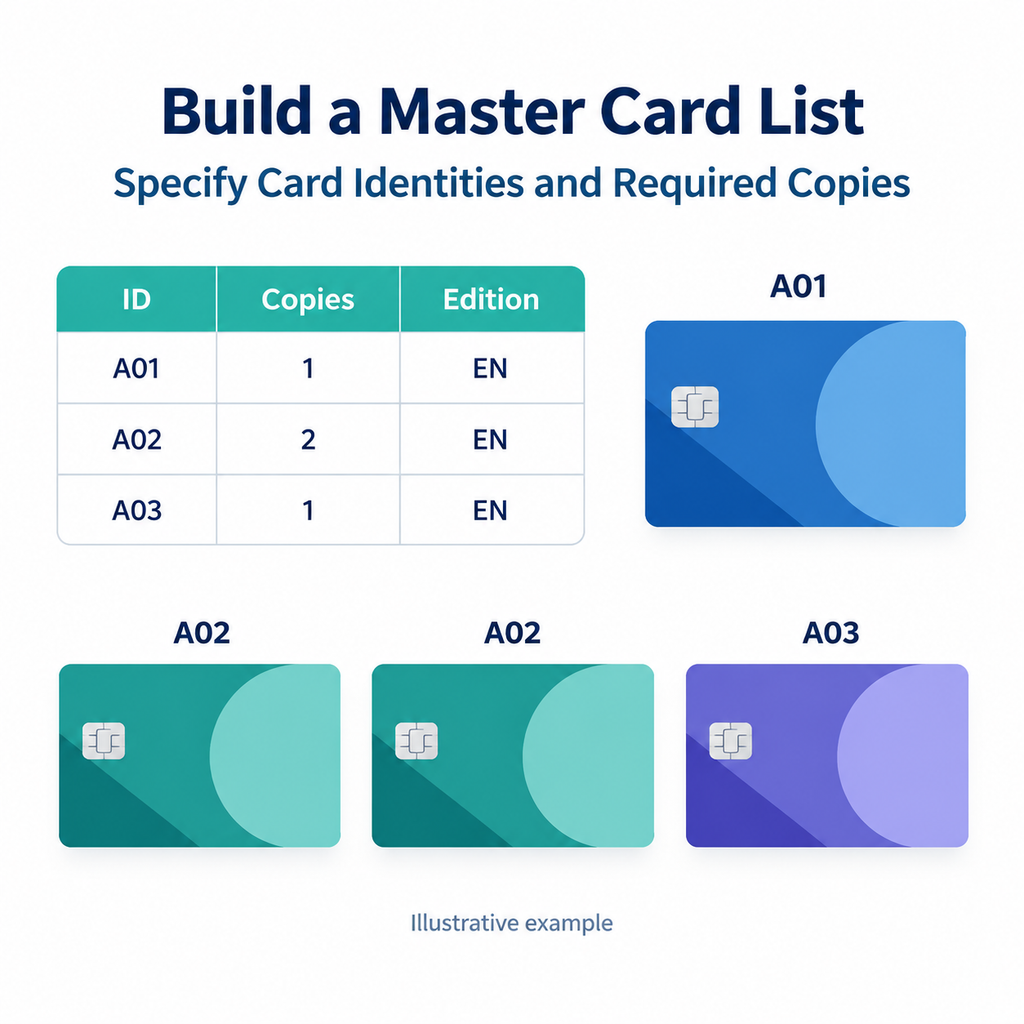
A master card list should identify each distinct card and state how many copies belong in one finished deck. Assign stable internal IDs even when the printed faces have no visible numbering.
- Deck reference: product name, SKU, edition, language, and approved revision.
- Card identity: unique ID, descriptive name, front artwork file, and matching back artwork file.
- Quantity: copies of each identity and the calculated total cards per deck.
- Assembly rule: position, group, orientation, and any permitted variation.
- Additional contents: instructions, dividers, promotional cards, or accessories, listed separately.
As an illustrative specification, 40 unique cards supplied once and five other identities supplied four times each produce 60 cards. The list must show all 45 identities and their required quantities, rather than simply saying “60 cards.”
Reconcile the list against final print files before approval. A corrected filename should not silently replace an approved design. The card artwork preparation guide explains supporting file requirements.
Define Card Sequencing and Deck Assembly Rules
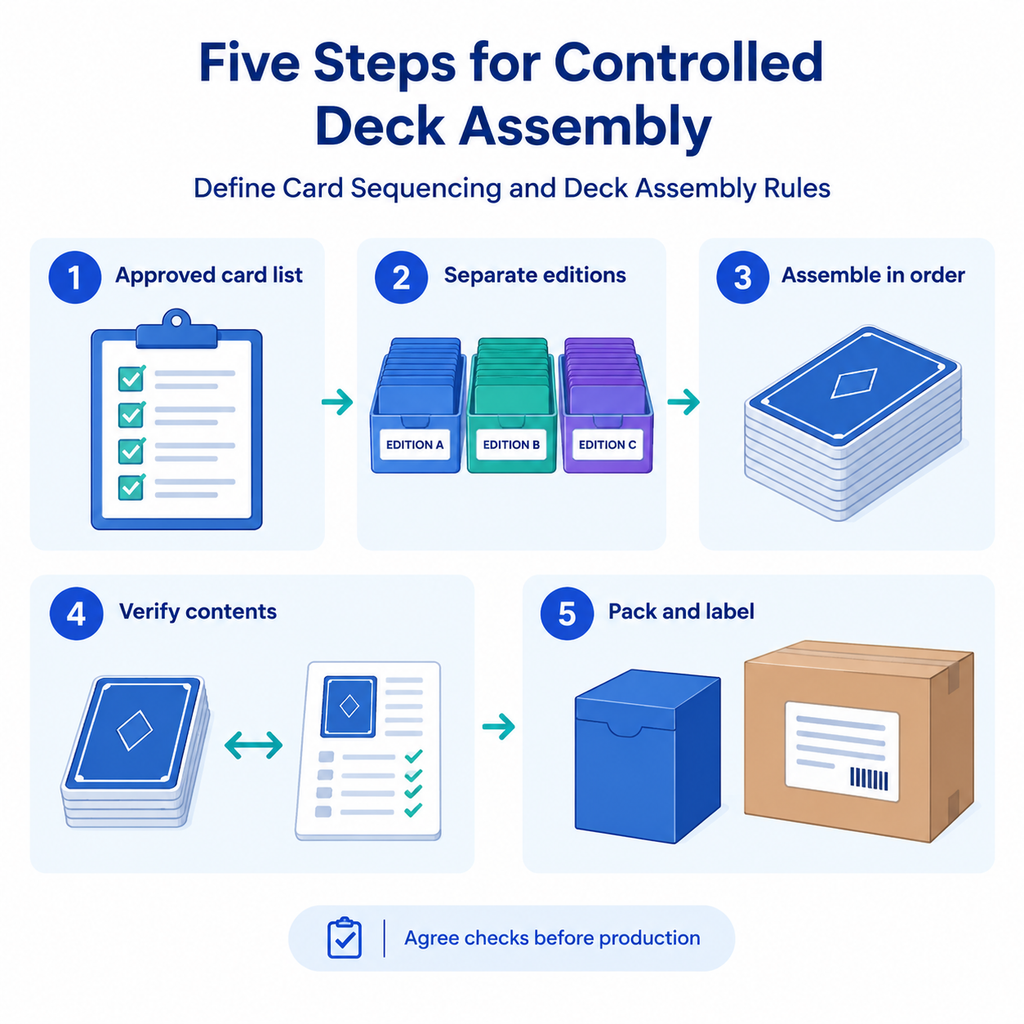
State whether the finished deck requires a fixed sequence, grouped sections, or unrestricted order. This decision affects the assembly method, inspection effort, and buyer experience.
- Define the starting face. Describe the deck as viewed when the customer opens the package.
- Specify the sequence. List exact IDs or define groups and their internal order.
- Set orientation. State whether all card tops point the same way and how double-sided cards should face.
- Locate inserts. Identify where instructions, dividers, and promotional cards belong.
- Record exceptions. Explain which groups may vary and which positions are mandatory.
“Random order” needs clarification: unrestricted order does not establish a statistically randomized distribution. If your product requires randomized assortments, rarity ratios, or variable contents, request a separate distribution specification and validation plan.
A simple visual flow supports the written instructions: approved card list → separated card groups → assembly → contents verification → packaging. Keep this reference at the assembly station.
Separate Language Editions and Product Versions
Multi-version card decks need separate identification throughout production, even when their backs, dimensions, and packaging look similar. Language editions should have their own approved card lists and component references.
Identify trays, work orders, inserts, and boxes with the edition and revision. Before switching editions, clear the assembly area of previous cards, labels, instructions, and packing materials. Reconcile remaining components so leftovers cannot enter the next run.
Shared components need explicit approval. An identical card back does not establish that two card faces are interchangeable. Similarly, a revised instruction booklet may change which cards belong in a deck.
Use edition codes alongside color cues, since color alone can be misread. Where retail identification is needed, consult the GS1 explanation of Global Trade Item Numbers for product identification principles. A barcode on the outer box identifies that item; it does not verify the identities of cards inside.
Compare Card Count and Identity Checks
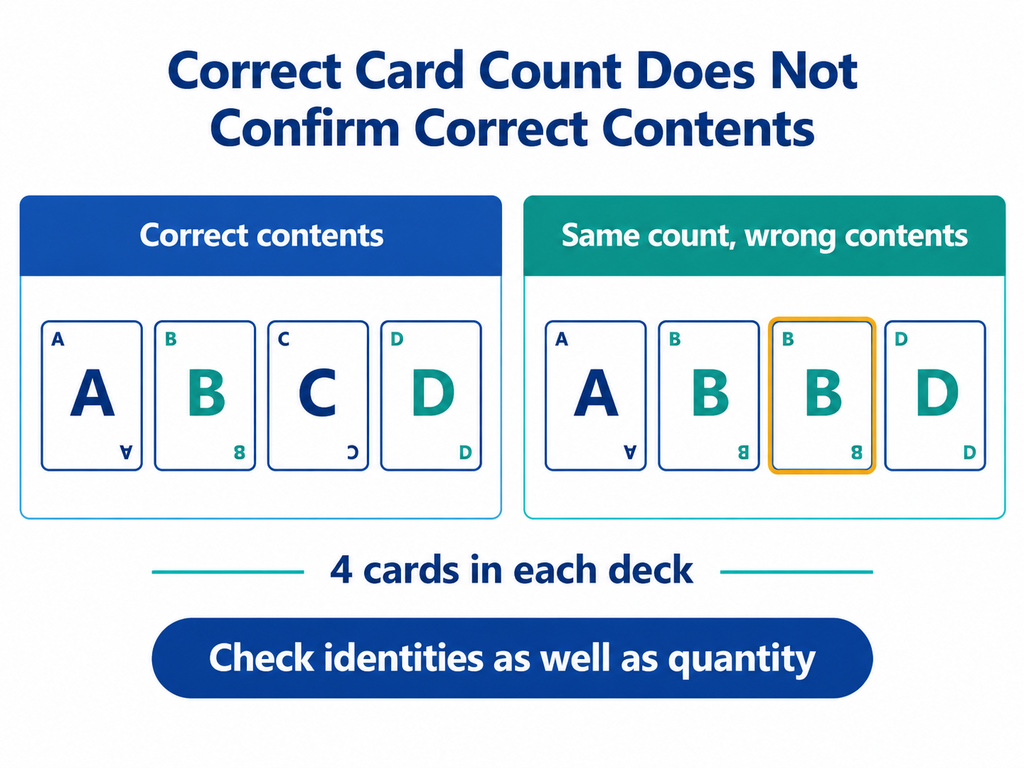
Card count verification and identity verification answer different questions. Agree which methods the factory will use, at what frequency, and how rejected decks will be isolated.
| Method | Useful for | Main limitation |
|---|---|---|
| Counting cards | Checking the total quantity | Cannot detect a missing identity replaced by a duplicate |
| Weight screening | Flagging possible quantity differences after validation | Material variation affects results; equal-weight substitutions can pass |
| Manual identity and sequence review | Comparing visible cards against the master list | Requires clear references and controlled handling |
| Camera or code inspection, if available | Recognizing configured identities or sequence positions | Needs suitable artwork, setup, challenge testing, and reject handling |
| Finished-deck sample audit | Checking contents after the complete assembly process | Only establishes results for inspected samples |
Do not assume automated inspection is included. Confirm equipment suitability for the specific deck. For any proposed method, challenge it with known errors: one missing card, an equal-count substitution, a wrong-language card, and an incorrect sequence.
Match Assembly Requirements to the Deck Type
Different products need different assembly instructions. Use this specification table to identify the checks your purchase order should describe.
| Deck type | Contents rule to specify | Priority check |
|---|---|---|
| Playing cards | Required ranks, suits, jokers, and extra cards | Complete identity set and agreed order |
| Game cards | Copies per identity, factions, starter groups, and inserts | Intentional duplicate quantities |
| Educational flash cards | Learning groups, languages, and answer-side pairing | Correct front/back pairing and edition |
| Tarot or oracle decks | Approved complete card list and guidebook version | Every required identity and matching booklet |
Physical specifications also affect handling. Confirm size, measured thickness, stock, coating or lamination, and corner shape. Cards that cling together or stick after finishing can complicate feeding and counting. Review these factors with the game card materials and finishes guide, then validate assembly using the intended construction.
Approve Samples Before Bulk Production
Approve a complete assembled sample against the master list before releasing bulk assembly. A flat artwork proof cannot demonstrate finished deck contents, order, or box fit.
- Approve card identities, quantities, front/back pairings, and edition files.
- Inspect a complete sample with its actual or agreed representative packaging.
- Record deviations and approve the corrected reference.
- Check initial production decks after assembly setup and edition changes.
- Release continued production against the approved specification.
Clarify whether the sample uses the intended stock, finish, cutting method, and assembly process. A hand-assembled prototype can confirm contents while leaving production feeding untested. The sample versus proof guide explains this distinction.
Specifications, MOQ, price, and lead time depend on project requirements. Unique card count, edition splits, finishing, inspection scope, and packaging all affect planning. Ask whether MOQ applies per language or SKU; splitting an order may require separate setup and verification work.
Set Inspection and Rework Rules
Effective card deck collation control requires a written response to defects, alongside inspection instructions. Define missing identities, excess copies, incorrect editions, reversed cards, and sequence errors as separate findings.
Agree the inspection frequency, sampling plan, acceptance criteria, and records before production. Sampling provides evidence about the inspected units and supports a lot decision; it does not prove every uninspected deck is correct.
If a defect appears, isolate the affected work and investigate its scope. Check feeder replenishment, component changes, interrupted assembly, and edition changeovers. Reworked decks should undergo a complete contents check before returning to approved stock.
YBJ Cards Printing brings 20+ years of experience and supports seven-stage quality control. Buyers should confirm where project-specific identity, count, sequence, and edition checks fit within that workflow. The number of QC stages alone does not define the inspection coverage for an individual order.
Use a Packing Checklist Through Shipping
Packaging must preserve the verified deck and keep editions identifiable through dispatch. Check contents before sealing, then verify the package and carton labels.
- Confirm deck SKU, language, revision, and approval status.
- Verify the booklet, accessories, and required inserts.
- Check box fit against the finished stack thickness.
- Confirm the agreed wrap, seal, band, or internal restraint.
- Record decks per carton, carton identification, and mixed-carton contents where permitted.
- Reconcile packed quantities with the shipment packing list.
Agree export carton protection for the selected transport route, including moisture protection where appropriate. Request a clear packing list separating editions so the receiving warehouse can identify stock without opening every retail box. Shipping mode, destination requirements, and any additional inspection or repacking affect the schedule and total cost.
Key Takeaways for Buyers
- Count: define total cards and copies per identity.
- Contents: connect each identity to approved artwork.
- Sequence: specify order, orientation, and inserts.
- Edition: separate languages, revisions, and packaging.
- Verification: combine quantity checks with suitable identity checks.
- Release: document inspection, rework, and packing approval.
Conclusion: Make Correct Contents Measurable
Reliable card deck collation starts with an approved contents list and carries through sampling, assembly, inspection, and packing. Define what belongs in each deck, how versions stay separate, and what evidence permits release. These practical controls help reduce missing cards, unintended duplicates, and costly corrections after delivery.
FAQ
Can a deck have the correct count but still contain missing cards?
Yes. A duplicate can replace a required identity while leaving the total count unchanged. Verify quantities per identity against the master card list, rather than relying only on total count or weight.
Must every card have a printed number for inspection?
No. Internal IDs can link artwork files to inspection references without appearing on the finished cards. Agree how inspectors will distinguish similar designs; visible identifiers or machine-readable codes require separate artwork approval.
How should intentional duplicate cards be specified?
List each distinct card identity once in the master list and state its required copies per deck. Calculate the total from those quantities and specify any grouping or sequence rules for repeated cards.
How can buyers reduce mixing between language editions?
Use separate edition references, approved component lists, identified work areas, and documented clearance between runs. Check that cards, instructions, retail boxes, and carton labels all match the intended edition.
Does checking every deck's weight guarantee correct contents?
No. Weight screening may flag quantity differences after validation, but equal-weight substitutions can pass. Combine it with suitable identity checks and an agreed inspection plan. Inspection scope and sample requirements affect price and lead time.
Ready to Start Your Custom Card Project?
Send us your card type, size, material, quantity, finish, and packaging requirements, along with your card list and any sequence or language-edition rules. Our factory team will discuss sampling and inspection requirements, recommend suitable production options, and prepare a tailored quote.
Keep Reading
Related Articles

Card Printing Quality Control: A Bulk Order Checklist
Use this practical bulk-order checklist to define acceptance criteria, inspect printed cards and complete decks, and document packaging and pre-shipment checks.

Card Printing Color Consistency: Proofs to Repeat Orders
Learn how to define color references, approve proofs, account for card stock and finishes, and manage repeat orders to reduce avoidable color variation.
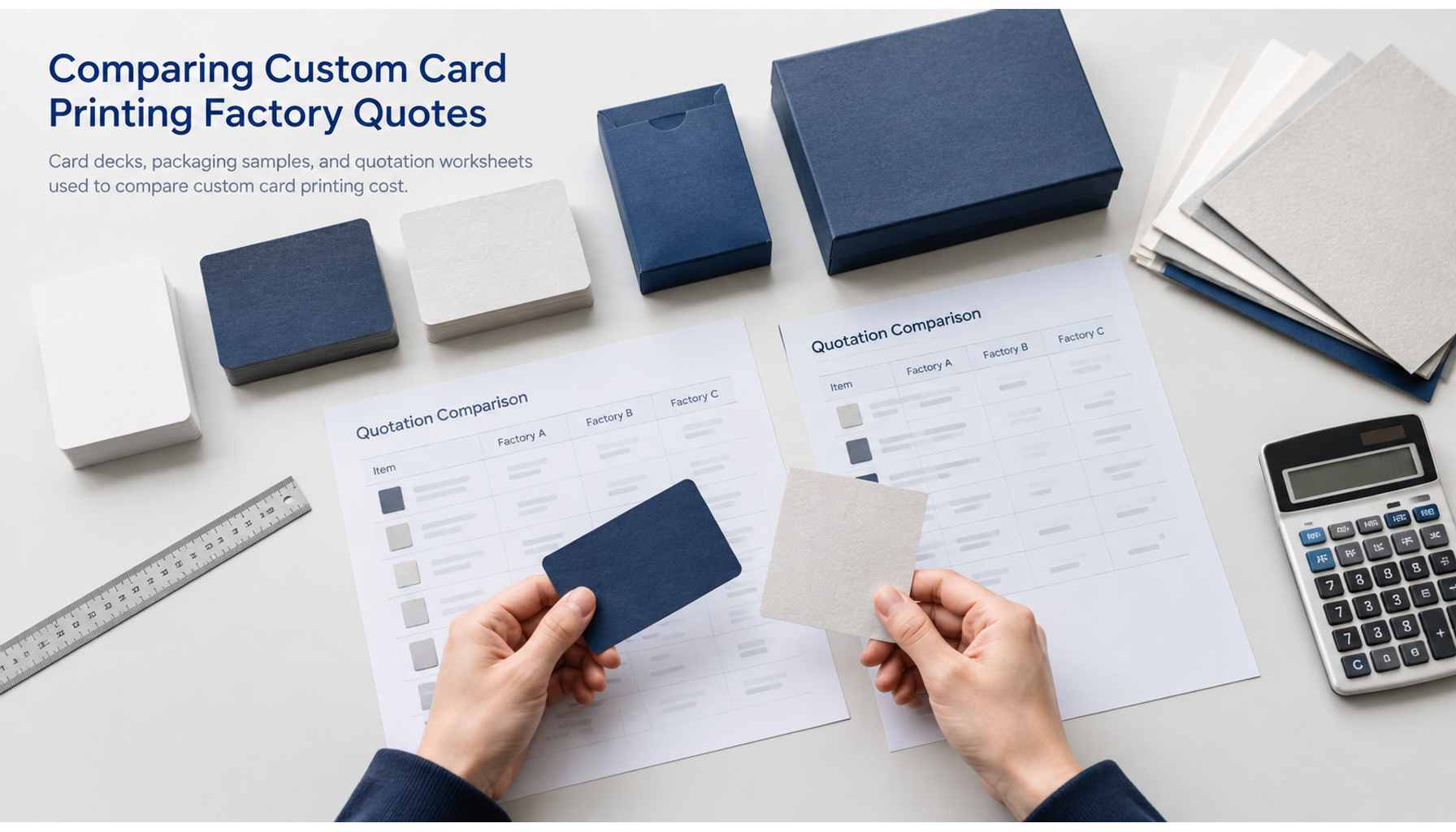
Custom Card Printing Cost: How to Compare Factory Quotes
Compare card printing quotations using the same deck specifications, packaging, quality requirements, and shipping scope. Learn how to separate unit prices, setup charges, and landed costs before choosing a factory.
Fast Quote Support
Ready to Start Your Custom Card Project?
Send us your product type, size, material, quantity, and packaging requirements. Our team will reply within 24 hours with production suggestions, sampling options, and a competitive quote. No setup fees.