
Sourcing Guides
Custom Card Printing Cost: How to Compare Factory Quotes
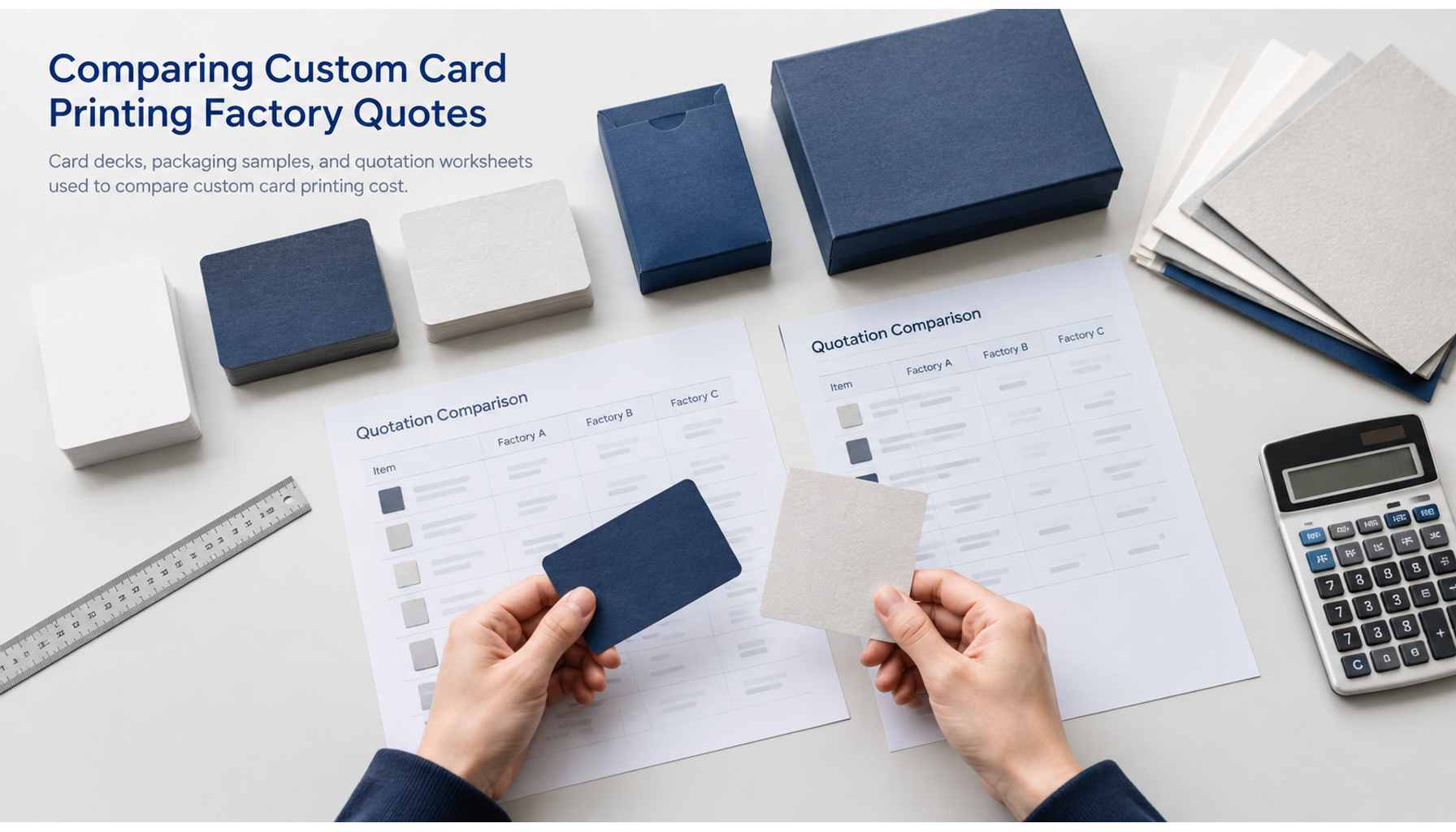
Table of Contents
- What Does Custom Card Printing Cost Include?
- Give Every Factory the Same Specification
- Understand the Main Manufacturing Cost Drivers
- Compare Product and Packaging Configurations
- Normalize Quotes Before Comparing Unit Prices
- Check MOQ, Samples, and Setup Charges
- Include Production and Quality Requirements
- Calculate Landed Cost at Your Destination
- Use a Five-Step Quote Review Process
- Key Takeaways for Comparing Quotes
- Frequently Asked Questions
- Conclusion: Compare the Complete Project Cost
Compare card printing quotations using the same deck specifications, packaging, quality requirements, and shipping scope. Learn how to separate unit prices, setup charges, and landed costs before choosing a factory.
What Does Custom Card Printing Cost Include?
To compare custom card printing cost accurately, give every factory the same written specification and compare the total cost of delivering the agreed finished product. A low price per deck is only meaningful when card count, material, finish, packaging, quality requirements, and shipping scope match.
There is no reliable universal price for a custom deck. Specifications, minimum order quantity, price, and lead time depend on project requirements. Ask suppliers to identify assumptions and exclusions before you shortlist a quotation.
- Unit price
- The price for one defined unit, such as a complete boxed deck. Confirm whether the quote means per card, per deck, or per set.
- Setup costs
- Charges for preparing production, which may include plates, cutting tools, artwork processing, or finishing tools.
- Landed cost
- The combined cost of goods and the applicable transport, import, and delivery charges needed to reach a specified destination.
For sourcing decisions, keep factory production cost and landed cost in separate columns. This makes both manufacturing differences and logistics assumptions visible.
Give Every Factory the Same Specification
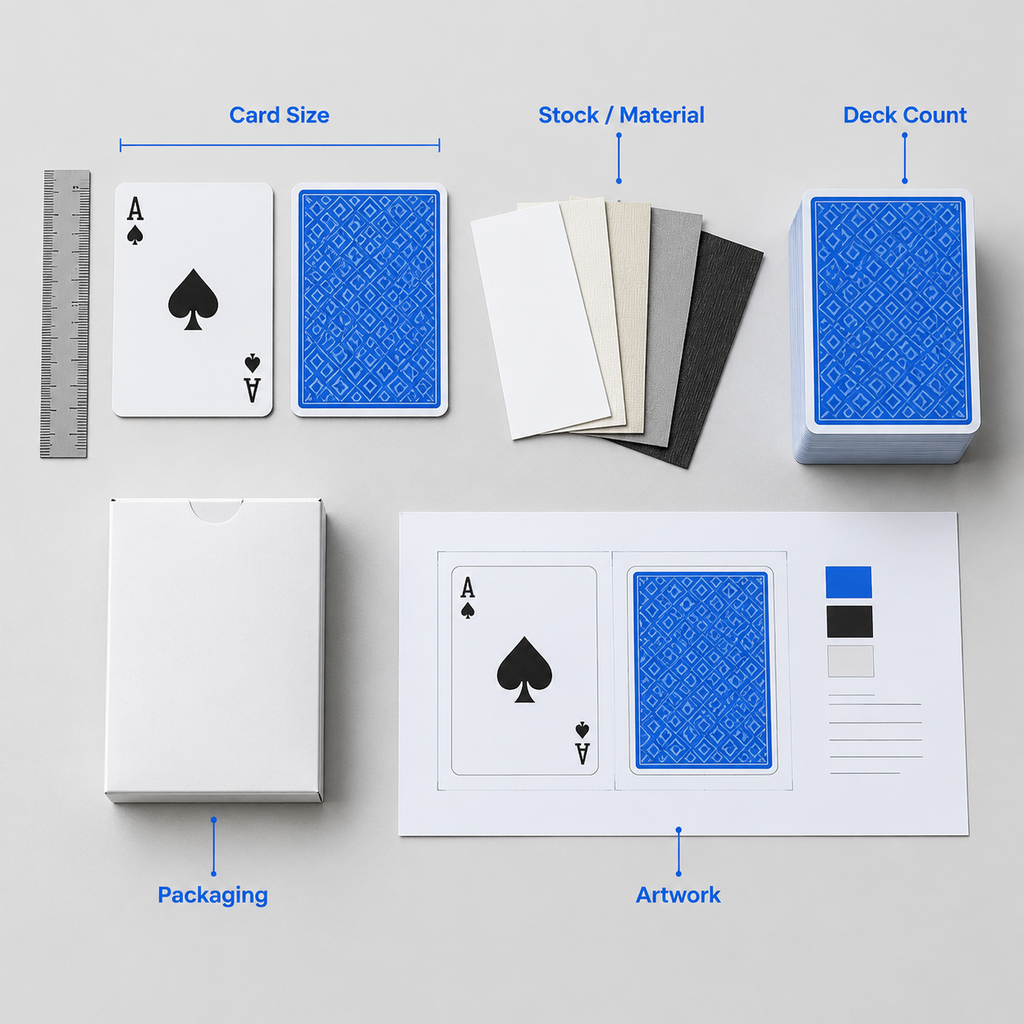
A useful bulk card printing quote starts with one shared specification sheet. Ask factories to quote that version and identify any proposed substitutions separately.
- Product: card type, intended use, finished dimensions, corner shape, and cards per deck.
- Quantity: finished decks per design, language, or SKU, plus quantities for alternative order tiers.
- Material: stock type, thickness or weight, core requirements, and any opacity or stiffness expectations.
- Printing: printed sides, number of unique faces and backs, full-color or spot-color requirements, and variable information.
- Finish: coating, lamination, texture, foil, edge treatment, or other requested operations.
- Packaging: box construction, printed surfaces, inserts, booklet page count, wrapping, and carton requirements.
- Delivery: destination postal code, shipping scope, required arrival date, and inspection requirements.
GSM means grams per square meter: it measures material weight per area, not thickness. Two stocks with the same GSM can handle differently. Use the card thickness and core selection guide to specify comparable materials.
For games, the game card specification guide helps connect stock and finish choices with handling requirements.
Understand the Main Manufacturing Cost Drivers
Card deck manufacturing cost depends on material use, production operations, and how efficiently the order fits the factory’s process. Quantity matters, but it cannot explain price without the underlying specifications.
Card count, dimensions, and artwork
More cards per deck increase material, printing, cutting, and collation requirements. Larger cards may reduce the number that fit on a production sheet. Ask whether a modest size adjustment would improve sheet utilization without compromising the product. Unique backs, multiple versions, and personalized data can also change preparation and checking work.
Materials and finishes
Stock construction affects opacity, stiffness, handling, and cost. Additional finishes introduce materials, setup, processing, and inspection requirements. Request a base specification and separately priced upgrades so you can assess each feature’s value.
Quantity and product mix
Larger runs can spread fixed printing setup costs across more units. However, several small designs may require separate preparation even when their combined order quantity is high. Ask suppliers whether pricing tiers apply per design, per SKU, or across the complete order.
Compare Product and Packaging Configurations
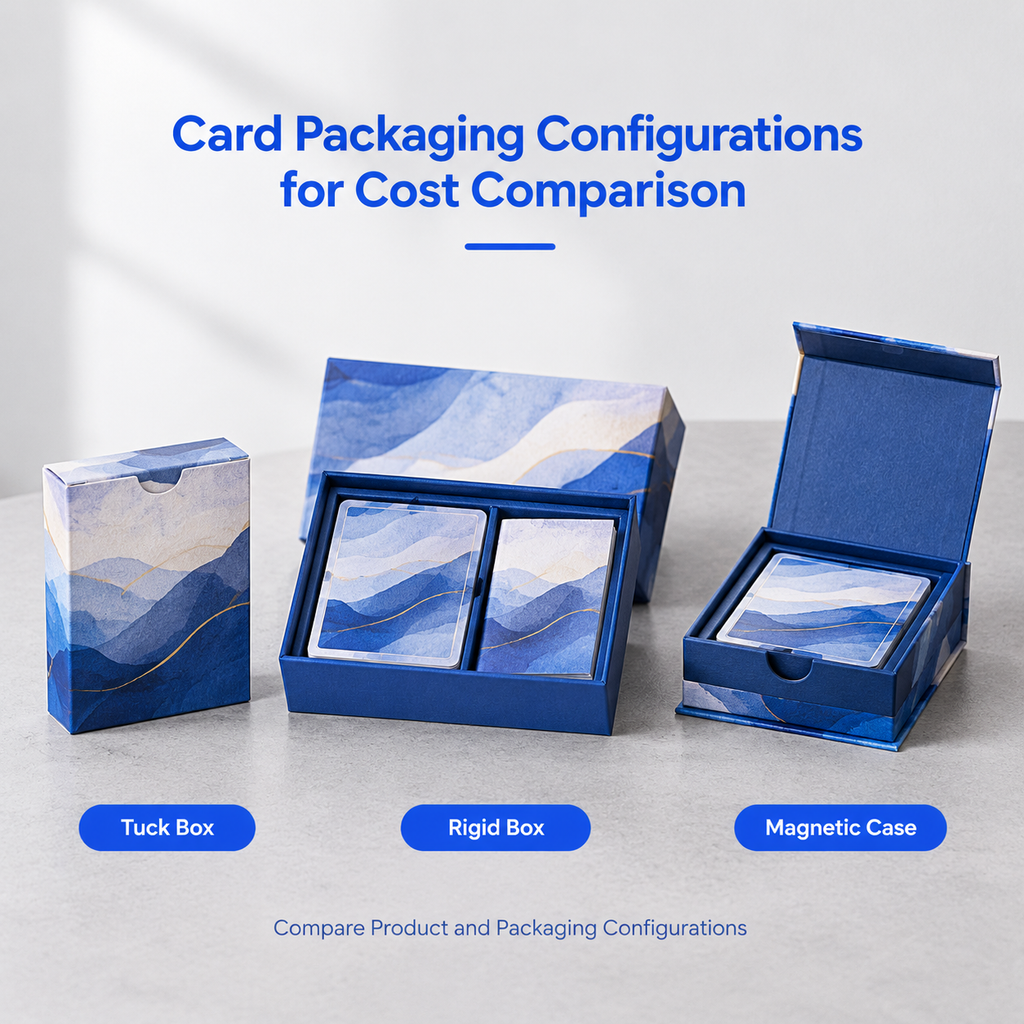
Compare complete product configurations before choosing individual upgrades. Packaging costs can change both the factory price and the freight calculation.
| Configuration | Typical buying priority | Cost questions to resolve |
|---|---|---|
| Game deck with a printed tuck box | Compact storage and repeated handling | Are the selected stock, finish, collation, and box assembly included? |
| Educational deck with a storage box | Readable cards and practical classroom storage | How do larger dimensions, card count, and box strength affect the quote? |
| Tarot or oracle deck with a rigid box and booklet | Presentation, protection, and supporting content | Are booklet printing, inserts, box wrapping, and assembly separately identified? |
| Promotional deck with simple retail packaging | Campaign budget and distribution efficiency | Are wrapping, labels, mailing protection, and version changes included? |
These are comparison configurations, not fixed product specifications. A rigid box may improve presentation but add packed volume; a tuck box generally uses less storage space. Compare tuck boxes, rigid boxes, and magnetic cases against your sales channel and shipping plan.
Normalize Quotes Before Comparing Unit Prices
Quote normalization means adjusting quotations to the same specification and commercial scope. Mark missing items as unresolved until the supplier confirms their price; do not treat a blank field as zero.
| Quote line | Required comparison basis | Clarification to request |
|---|---|---|
| Unit price | One complete deck at the same quantity | Does it include every card, accessory, and retail package? |
| Material and finish | Same specified construction and surface treatment | Is any quoted material a proposed substitute? |
| Setup and tooling | Separate one-time and recurring charges | What can be reused on an unchanged repeat order? |
| Samples | Equivalent sample type and delivery scope | Are custom finishes and sample shipping included? |
| Packing and inspection | Same cartons, labels, checks, and acceptance criteria | Are special packing or independent inspection fees extra? |
| Shipping and imports | Same destination and allocation of responsibilities | Which freight, clearance, duty, and delivery charges are excluded? |
Also record quote currency, payment schedule, validity period, and permitted delivery quantity variation. Compare totals using a stated exchange-rate assumption. If one quotation is substantially lower, ask which specification or service explains the difference.
Check MOQ, Samples, and Setup Charges
MOQ means minimum order quantity. Confirm whether it applies to the finished deck, each artwork version, or a particular material or packaging component. Request prices at realistic quantities rather than choosing a larger run solely for its lower unit price.
Separate existing reference samples, digital proofs, custom prototypes, and production-representative samples. A digital proof helps review content and layout but cannot establish physical stock feel. A prototype made by a different process may not reproduce the final finish or color exactly.
Ask what the sample demonstrates, its charge, shipping cost, revision allowance, and whether any fee is credited against production. For tooling, establish ownership, storage, reuse conditions, and repeat-order charges. Do not assume all setup charges disappear on a reorder.
Include Production and Quality Requirements
A comparable quote must include the checks needed to deliver usable decks. Agree on the approved reference, color expectations, cutting and registration tolerances, card sequence, packaging condition, and defect acceptance criteria.
Collation means assembling cards in the required count and sequence. Confirm how missing, duplicate, or mixed-version cards are checked. If cards contain scannable codes, specify the required verification scope using the QR code and barcode printing guide.
YBJ Cards Printing brings 20+ years of experience and supports artwork review, sampling, bulk production, seven-stage quality control, export packing, and worldwide shipping. Ask how the proposed inspection plan addresses your project and whether additional testing or third-party inspection is included.
Separate artwork approval, sample approval, production, inspection, and transit in the schedule. Confirm the production start conditions and revision impact before accepting a lead-time estimate.
Calculate Landed Cost at Your Destination
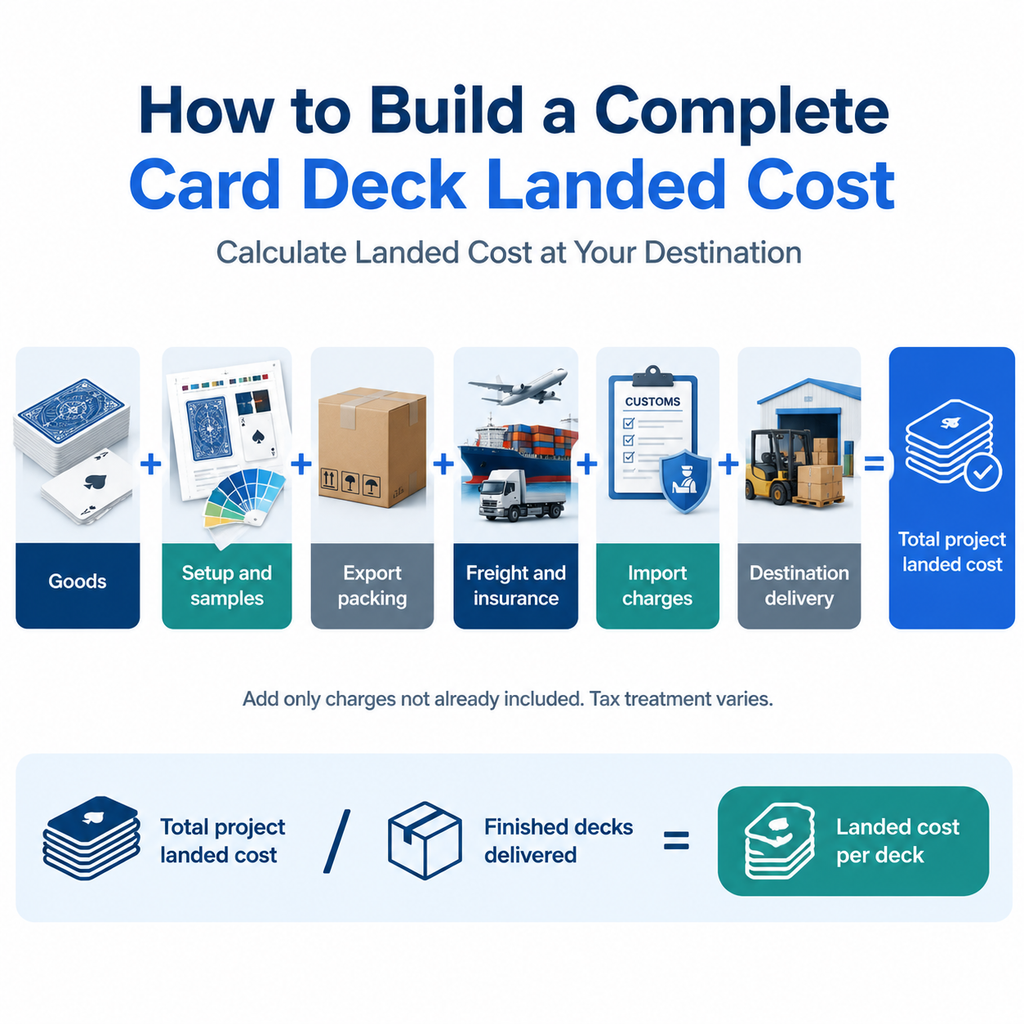
Landed cost makes quotations comparable at the same delivery point. Start with the complete goods total, then add applicable charges that are not already included.
Total project landed cost = goods + setup and samples + export packing + freight and insurance + clearance and duties + applicable nonrecoverable taxes + destination delivery.
Landed cost per deck = total project landed cost ÷ confirmed finished decks delivered.
Count each charge once. If packaging is included in the deck price, do not add it again. Track recoverable import taxes separately for cash-flow planning; confirm treatment with your adviser or broker.
Request carton quantity, dimensions, gross weight, freight method, and quotation validity. Air and courier pricing may depend on volumetric weight: a space-based chargeable weight. Bulky boxes can therefore affect shipping costs even when card weight stays similar.
Use a named place and an agreed Incoterms® rule where appropriate. The International Chamber of Commerce’s Incoterms rules overview explains this framework for allocating delivery responsibilities, costs, and risks. Confirm exclusions with the supplier and freight provider; the trade term alone is not a complete landed-cost calculation.
Use a Five-Step Quote Review Process
A consistent review process turns supplier quotations into a purchasing decision.
- Issue one specification. Give each factory the same revision, quantities, destination, and required dates.
- Resolve deviations. Request a compliant base quote, with alternative materials or packaging priced separately.
- Build a comparison sheet. Record included items, exclusions, one-time charges, unit totals, payment terms, and delivery scope.
- Validate the product. Review suitable samples and agree on quality criteria before bulk approval.
- Confirm the purchase basis. Put specifications, approved references, schedule milestones, packing, inspection, and discrepancy handling into the order documents.
For savings, ask the factory to price one change at a time: standard dimensions, simpler packaging, fewer finish operations, or consolidated versions. This shows which change reduces total cost while preserving the product’s intended use.
Key Takeaways for Comparing Quotes
- Define the quoted unit and match every deck specification.
- Separate recurring production costs from setup, sampling, and tooling.
- Include packaging, collation, inspection, and export packing.
- Compare landed totals at the same destination and quantity.
- Resolve exclusions and substitutions before approving the order.
Frequently Asked Questions
These answers address common questions about comparing factory quotations.
Conclusion: Compare the Complete Project Cost
The most useful custom card printing cost comparison connects an agreed specification with a complete delivery scope. Evaluate unit prices alongside setup, sampling, packaging, quality checks, and logistics. Once those items match, you can judge each quotation on product suitability, total spending, and execution requirements.
FAQ
Why do factories quote different prices for the same card deck?
Factories may assume different stock, finishes, packaging, quantities, inspection scope, or delivery responsibilities. Production methods and purchasing conditions also differ. Request a line-by-line specification confirmation before deciding whether the quotations cover the same product.
Does a higher order quantity always reduce total project cost?
A larger order may reduce the price per deck by spreading setup costs, while increasing total spending, freight, and storage needs. Compare realistic sales quantities and cash requirements. Ask whether quantity breaks apply per design or across the entire order.
Are samples and printing setup costs included in the unit price?
They may be included, listed separately, or partly credited after a production order. Ask for written confirmation covering sample type, revisions, shipping, tooling, and repeat-order charges. Never assume that a sample credit or reusable tooling is included.
How should I compare packaging costs between suppliers?
Match box construction, dimensions, material, print coverage, inserts, wrapping, and assembly. Then compare packed carton dimensions and weight. A lower box price does not necessarily produce a lower landed cost if the configuration needs more shipping space or protection.
What information is needed for an accurate custom card printing cost estimate?
Provide card type, dimensions, cards per deck, material, artwork versions, quantity per version, finish, packaging, and destination. Include sample expectations and timing. Specifications, MOQ, price, and lead time depend on project requirements and should be confirmed in the quotation.
Ready to Start Your Custom Card Project?
Send us your card type, size, material, quantity, finish, and packaging requirements. Our factory team will recommend suitable production and sampling options and prepare a tailored quote. Include your cards per deck and delivery destination so we can clarify the production and shipping scope.
Keep Reading
Related Articles
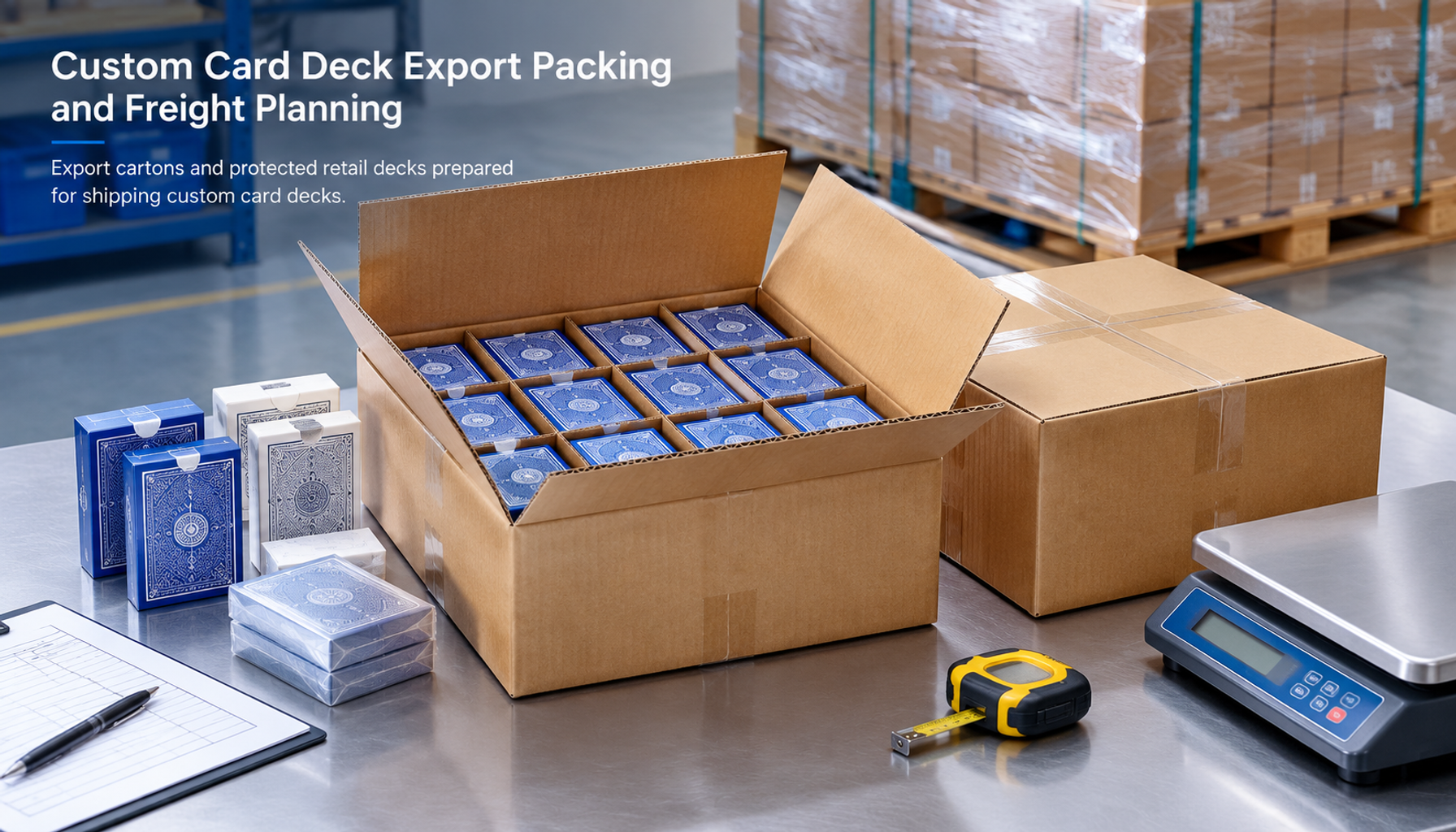
Shipping Custom Card Decks: Plan Cartons, Freight, and Landed Costs
Build a practical shipping plan for finished card decks: specify protective export cartons, calculate shipment volume, compare freight options, and clarify destination charges before booking.
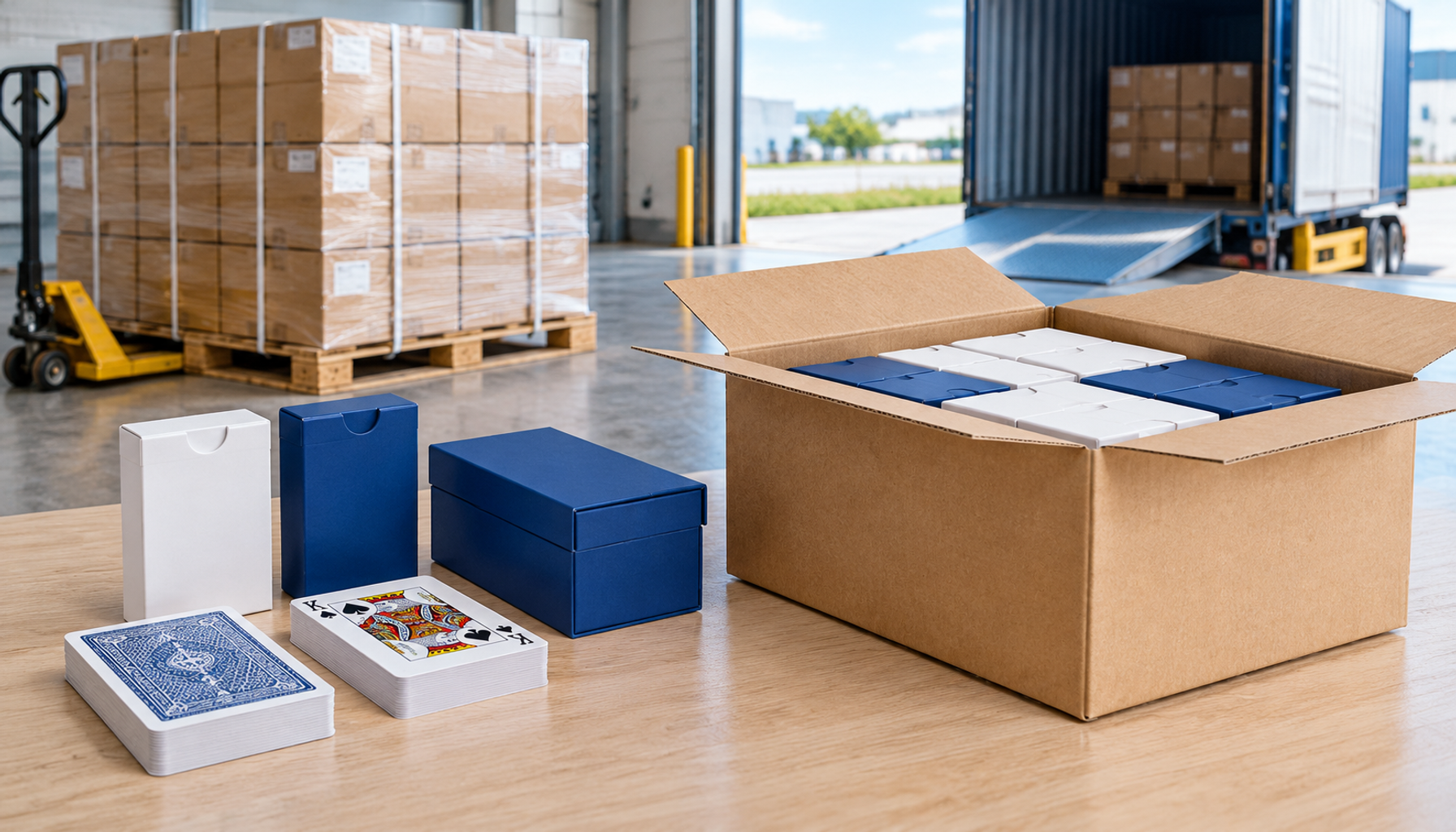
Shipping Custom Cards from China: A B2B Planning Guide
Plan your card shipment around packed dimensions, freight options, export protection, shipping terms, and destination charges. This guide explains how to connect factory production with a realistic delivery budget and receiving plan.

Card Printing Quality Control: A Bulk Order Checklist
Use this practical bulk-order checklist to define acceptance criteria, inspect printed cards and complete decks, and document packaging and pre-shipment checks.
Fast Quote Support
Ready to Start Your Custom Card Project?
Send us your product type, size, material, quantity, and packaging requirements. Our team will reply within 24 hours with production suggestions, sampling options, and a competitive quote. No setup fees.