
Production & Quality
Card Printing Quality Control: A Bulk Order Checklist

Table of Contents
- What Card Printing Quality Control Means
- Set Acceptance Criteria Before Production
- Bulk Order Quality Checkpoints
- Inspection Methods Compared
- Product-Specific Inspection Checklist
- A Step-by-Step Inspection Process
- Conclusion
Use this practical bulk-order checklist to define acceptance criteria, inspect printed cards and complete decks, and document packaging and pre-shipment checks.
What Card Printing Quality Control Means
Card printing quality control is the planned checking of materials, printing, finishing, assembly, and packing against agreed specifications. For a bulk order, buyers should approve measurable requirements before production and use a representative sample and documented inspection plan to judge the finished goods.
Quality control (QC) means checks performed during and after production to identify defects or variation. Acceptance criteria are the written requirements used to decide whether a product is acceptable, needs rework, or should be discussed before shipment. They should cover appearance as well as functional requirements such as deck count, sequence, and packaging.
A proof confirms artwork and layout; it does not by itself demonstrate that the bulk run will match the approved material, color, finish, or assembly. For repeatable evaluation, agree which approved sample or signed proof is the reference, how defects are classified, how samples are selected, and who approves shipment. Specifications, MOQ, price, and lead time depend on project requirements.
Set Acceptance Criteria Before Production
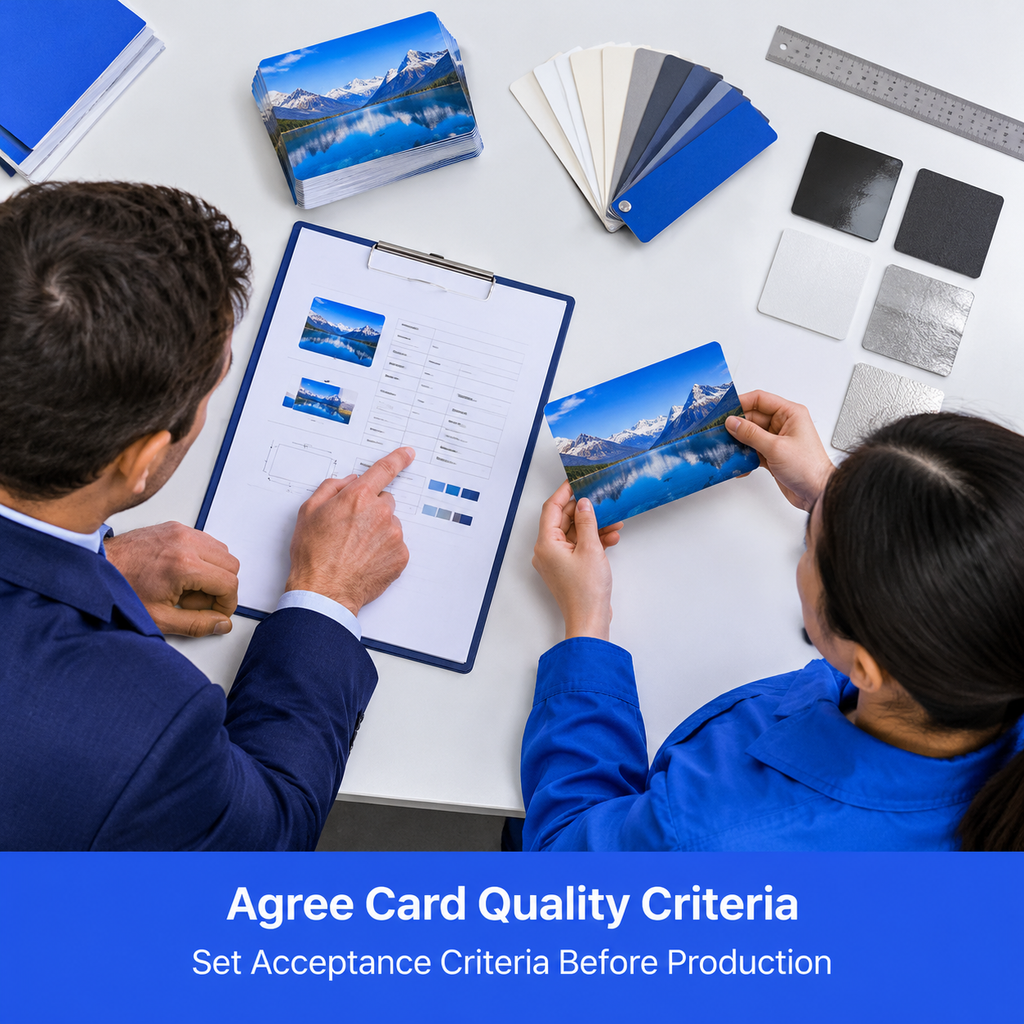
Start with a written specification that both buyer and manufacturer can use. Include the approved artwork version, card dimensions, material and thickness, finish, quantity, card count and sequence per deck, packaging configuration, and export packing requirements. If you are still deciding stock or construction, review this card thickness and material guide before approving the production sample.
Define how visual checks will be made. State the approved color reference, viewing conditions where relevant, and whether the signed production sample or a specified proof is the comparison standard. A numeric color tolerance should only be used when the parties have agreed on a measurement method, device, and reference; otherwise, document a practical visual approval method.
- Critical defects: issues that make a card unsafe, unusable, or materially different from the order, such as an incorrect card face or missing required information.
- Major defects: defects that affect normal use or sale, such as visibly misregistered printing, a wrong cut, or an incomplete deck.
- Minor defects: small cosmetic variations that do not materially affect use, subject to the agreed acceptance standard.
These categories are a planning aid, not a universal pass/fail rule. Agree examples and any sampling or defect limits in writing before the order is produced. Reference the same files and specifications when discussing game-card production requirements.
Bulk Order Quality Checkpoints
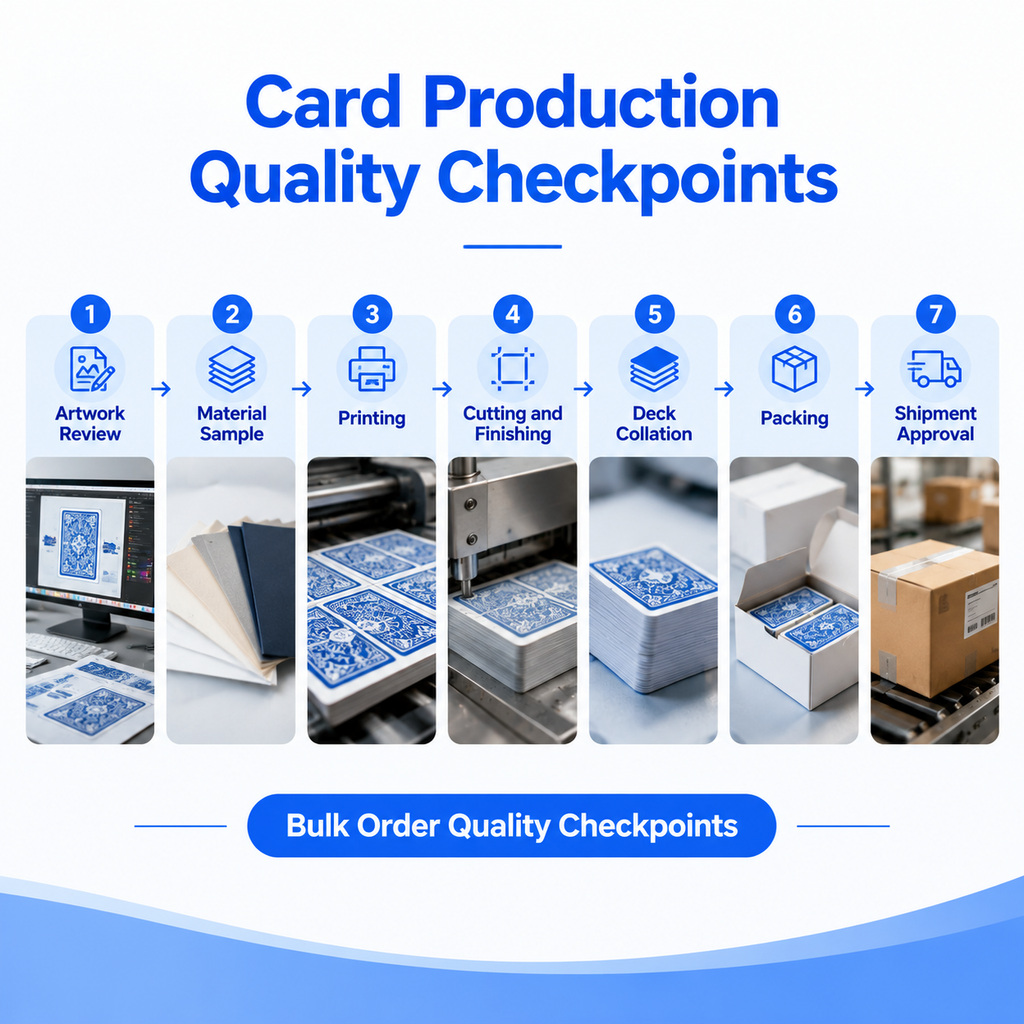
Inspect at more than one stage. A finished-carton check can catch packing problems, but it may not reveal a recurring print or assembly issue that could have been corrected earlier. Ask the manufacturer to record checks at the points that matter to your product and order.
- Artwork and file review: confirm the approved revision, card backs and faces, bleed, orientation, sequence, and any variable data. For codes, define scan or data validation requirements; see this guide to QR code and barcode card checks.
- Material and sample approval: verify the selected stock, thickness, finish, dimensions, and packaging against the approved sample. Changes to material or coating can affect feel and appearance.
- Printing: check color consistency, legibility, ink coverage, smudging, and print registration. Print registration is the alignment of printed colors or layers with each other and with the intended artwork position.
- Cutting and finishing: check dimensions, edge condition, corner shape, coating or laminate coverage, and consistency across sampled cards. Cutting tolerances should be agreed in context of the card size, equipment, and intended use.
- Assembly and card collation: count cards, verify sequence and orientation, and inspect for missing, duplicated, or mixed-up faces. Card collation is the arranging of individual cards into the specified deck order.
- Packing and shipment release: confirm units per pack, box fit, labels, carton condition, and export packing details. Record inspection findings and approval before dispatch.
These checkpoints complement the factory’s broader inspection system. Ask how findings are recorded, how nonconforming units are separated, and how corrective action is confirmed. For context on production facilities and process scope, review the YBJ Cards Printing factory overview.
Inspection Methods Compared
Choose inspection coverage based on order risk, product complexity, and the consequences of a defect. A method name alone does not set a pass threshold: sampling plans and acceptance limits must be agreed for the order.
| Method | What it checks well | Trade-off | Useful for |
|---|---|---|---|
| In-process checks | Early print, finish, and assembly issues | Requires timely records and response during production | Orders with multiple production stages or complex decks |
| Sample-based inspection | Representative appearance, dimensions, collation, and packing | A sample cannot guarantee every unit is defect-free | Routine bulk orders with agreed sampling rules |
| 100% checking of a defined feature | Specific countable or machine-verifiable requirements | Scope, method, and record keeping need to be clear | Features such as deck count or code scan checks when feasible |
| Pre-shipment inspection | Finished goods, cartons, labels, and order configuration | Late findings may affect the shipment schedule | Final release when buyer approval is required |
For reference, ISO 2859-1 describes sampling procedures indexed by acceptance quality limit (AQL) for lot-by-lot inspection. An AQL is a parameter used in a sampling scheme; it is not a promise that a specific percentage of defects is acceptable in every shipment. Do not apply an AQL number without agreeing the standard edition, inspection level, sample size, defect classes, and acceptance/rejection numbers. See the ISO 2859-1 standard page for the scope of the standard.
Product-Specific Inspection Checklist
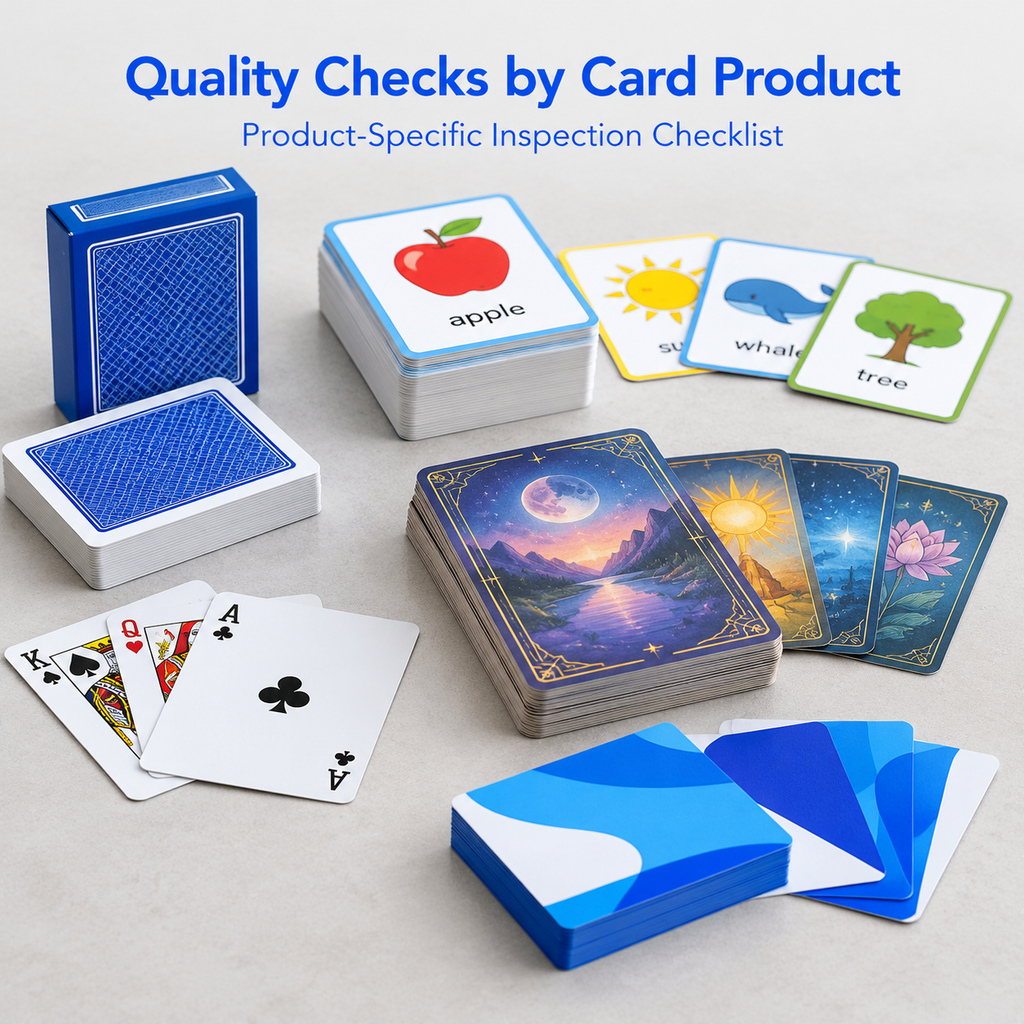
Different card products call for different checks. Use this comparison to tailor a product checklist rather than applying a single visual standard to every order.
| Product type | Priority checks | Useful evidence |
|---|---|---|
| Game or playing-card deck | Face and back accuracy, registration, cut consistency, card count, sequence, shuffle feel, and tuck-box fit | Approved deck sample, count record, and sampled deck-opening checks |
| Flash or educational cards | Readable text, correct question-answer pairing, sequence, color coding, and rounded or square corner specification | Approved content list and checklist of selected cards |
| Tarot or oracle deck | Artwork integrity, subtle color variation, border alignment, surface finish, deck order, and protective packaging | Approved visual reference and finish sample |
| Promotional or membership cards | Logo and variable-data accuracy, dimensions, surface finish, barcode or QR readability where specified, and pack labels | Artwork revision record and agreed functional test results |
Packaging is part of the finished product, not an afterthought. Confirm whether cards should be shrink-wrapped, boxed, banded, or otherwise protected, and check that the pack prevents movement or edge damage in transit. Compare suitable card packaging options against the deck dimensions and shipping plan.
A Step-by-Step Inspection Process
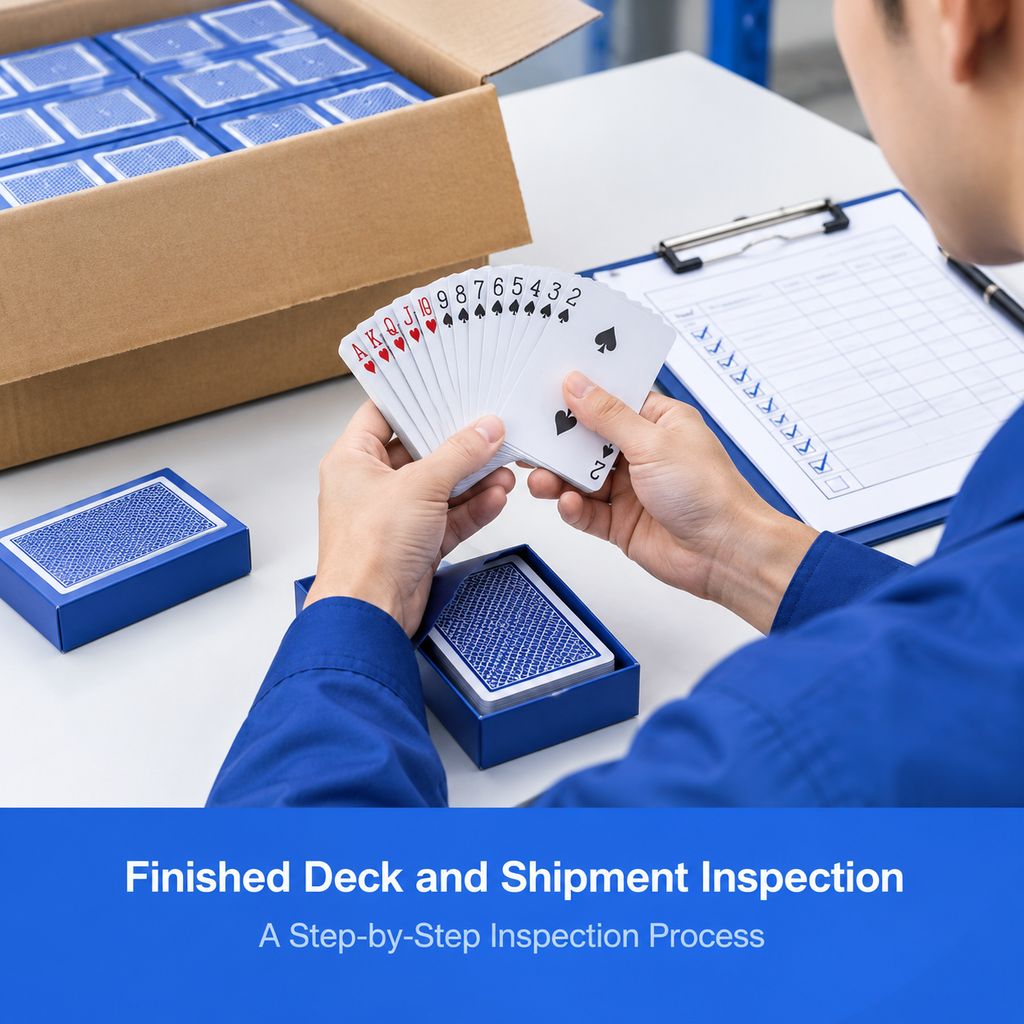
- Freeze the specification. Confirm the artwork revision, card construction, dimensions, finish, count, order quantity, packaging, and labeling in one approved document.
- Approve the production reference. Keep a dated sample or other agreed reference. Note what it represents; a digital proof may not show the final material, coating, or color appearance.
- Agree the inspection plan. Decide when checks occur, who performs them, which cartons or decks are selected, what defects are critical, major, or minor, and what results trigger corrective action or shipment hold.
- Review production records. Ask for relevant checks on material, print, finishing, collation, and packing. For repeat orders, compare against the approved reference and review changes in inputs or process.
- Conduct card deck inspection. Open selected finished decks. Check count, sequence, orientation, backs, faces, dimensions, edges, finish, and package fit. Record the observed defects and sample basis rather than relying on a general statement that goods “look good.”
- Complete pre-shipment inspection. Verify finished quantities, carton labels, packing configuration, and visible carton condition. Photograph findings and record approval, rejection, or corrective actions before release.
- Keep a closeout file. Retain the specification, approval reference, inspection notes, images, and shipment release record for repeat production and any claim investigation.
When a defect is found, describe its location, frequency, and effect; attach clear photos; and ask for containment and corrective action. Do not rely on a vague instruction such as “make it better.” If the issue affects acceptance, pause shipment approval until the parties agree on rework, replacement, concession, or another documented resolution.
Conclusion
Effective card printing quality control starts before the press run: write down the product specification, approve a production reference, and agree how defects will be sampled and judged. Check printing, cutting, collation, packaging, and shipment as connected stages, then document the pre-shipment decision. A practical checklist gives both buyer and manufacturer a shared basis for resolving variation and approving a bulk order.
FAQ
What should a bulk card quality checklist include?
Include artwork revision, card size and material, finish, color reference, print registration, cutting and edge checks, card count and sequence, packaging, carton labeling, sampling method, defect categories, and shipment-approval responsibility.
How do I check color consistency in a card printing order?
Compare production cards with the agreed reference under consistent viewing conditions. Identify the approved artwork and reference sample in writing. If using instrument readings or numeric tolerances, agree on the device, measurement method, and acceptable range before production.
Can a sample-based inspection guarantee every deck is correct?
No. Sampling evaluates selected units and can identify patterns of defects, but it does not verify every card or deck. Define the sampling plan and acceptance limits with the manufacturer; use 100% checks for a specific feature only where the method and scope are practical and documented.
What is checked during pre-shipment inspection?
Typical checks include finished product appearance, card count and collation in selected decks, packaging configuration, quantities, labels, and visible carton condition. The inspection plan should state the sample basis, defect criteria, and how approval or corrective action is recorded.
When should buyers approve the quality control plan?
Approve it before bulk production. Confirm the reference sample, specification, checkpoints, defect classifications, sampling rules, and shipment-release process before manufacturing begins. Specifications, MOQ, price, and lead time depend on project requirements.
Ready to Start Your Custom Card Project?
Share your card type, size, material, quantity, finish, and packaging requirements, along with any sampling or inspection criteria you need. Our factory team can discuss suitable production and sampling options and prepare a tailored quote.
Keep Reading
Related Articles

Card Deck Collation: Prevent Missing and Duplicate Cards
A complete deck requires more than the correct card count. Learn how to specify card identities, intentional duplicates, sequence rules, language editions, and packing checks before bulk production.

Card Printing Color Consistency: Proofs to Repeat Orders
Learn how to define color references, approve proofs, account for card stock and finishes, and manage repeat orders to reduce avoidable color variation.
Custom Card Printing Cost: How to Compare Factory Quotes
Compare card printing quotations using the same deck specifications, packaging, quality requirements, and shipping scope. Learn how to separate unit prices, setup charges, and landed costs before choosing a factory.
Fast Quote Support
Ready to Start Your Custom Card Project?
Send us your product type, size, material, quantity, and packaging requirements. Our team will reply within 24 hours with production suggestions, sampling options, and a competitive quote. No setup fees.