
Sourcing Guides
Shipping Custom Card Decks: Plan Cartons, Freight, and Landed Costs
Table of Contents
- Shipping Custom Card Decks Starts with the Packed Shipment
- Shipping Terms Buyers Need to Define
- Specify Export Packing Around Handling Risks
- Match Deck Formats to Transport Packing
- Calculate Carton Volume and Chargeable Weight
- Compare Courier, Air Freight, and Sea Freight
- Clarify Incoterms and Destination Costs
- Approve Samples, Production, and Dispatch in Order
- Prepare Documents and Receiving Instructions
- Key Takeaways for a Comparable Freight Quote
- Conclusion: Approve the Shipment Specification Early
Build a practical shipping plan for finished card decks: specify protective export cartons, calculate shipment volume, compare freight options, and clarify destination charges before booking.
Shipping Custom Card Decks Starts with the Packed Shipment
The best approach to shipping custom card decks is to confirm the packed carton dimensions, gross weight, destination, and delivery responsibilities before choosing freight. Compare complete transport costs using the same shipment specification. A low freight rate can become expensive when destination handling, customs clearance, or final delivery is excluded.
Design the shipping plan alongside the deck specification. Card count, stock thickness, booklets, and retail boxes affect shipment weight and volume. Changes after sampling can invalidate an earlier freight estimate.
YBJ Cards Printing is a China-based manufacturer with more than 20 years of experience supporting artwork review, sampling, bulk production, seven-stage quality control, export packing, and worldwide shipping. Specifications, MOQ, price, and lead time depend on project requirements.
Shipping Terms Buyers Need to Define
Separate product measurements from shipping measurements when requesting a quote.
- Net weight
- The weight of the goods, with the packing-list convention agreed between the parties.
- Gross weight
- The total packed weight, including cartons and other transport packaging.
- Carton dimensions
- The external length, width, and height of a sealed shipping carton.
- Dimensional weight
- A calculated weight based on package volume, used by carriers to account for the space a shipment occupies.
- Chargeable weight
- The weight used for freight billing under the carrier’s applicable calculation, minimums, and rounding rules.
- Incoterms
- ICC trade rules allocating specified delivery obligations, costs, and risks between seller and buyer.
A retail tuck box protects an individual deck. An export carton groups finished decks for transport. Pallets, when used, create another handling unit with additional dimensions and weight.
Specify Export Packing Around Handling Risks
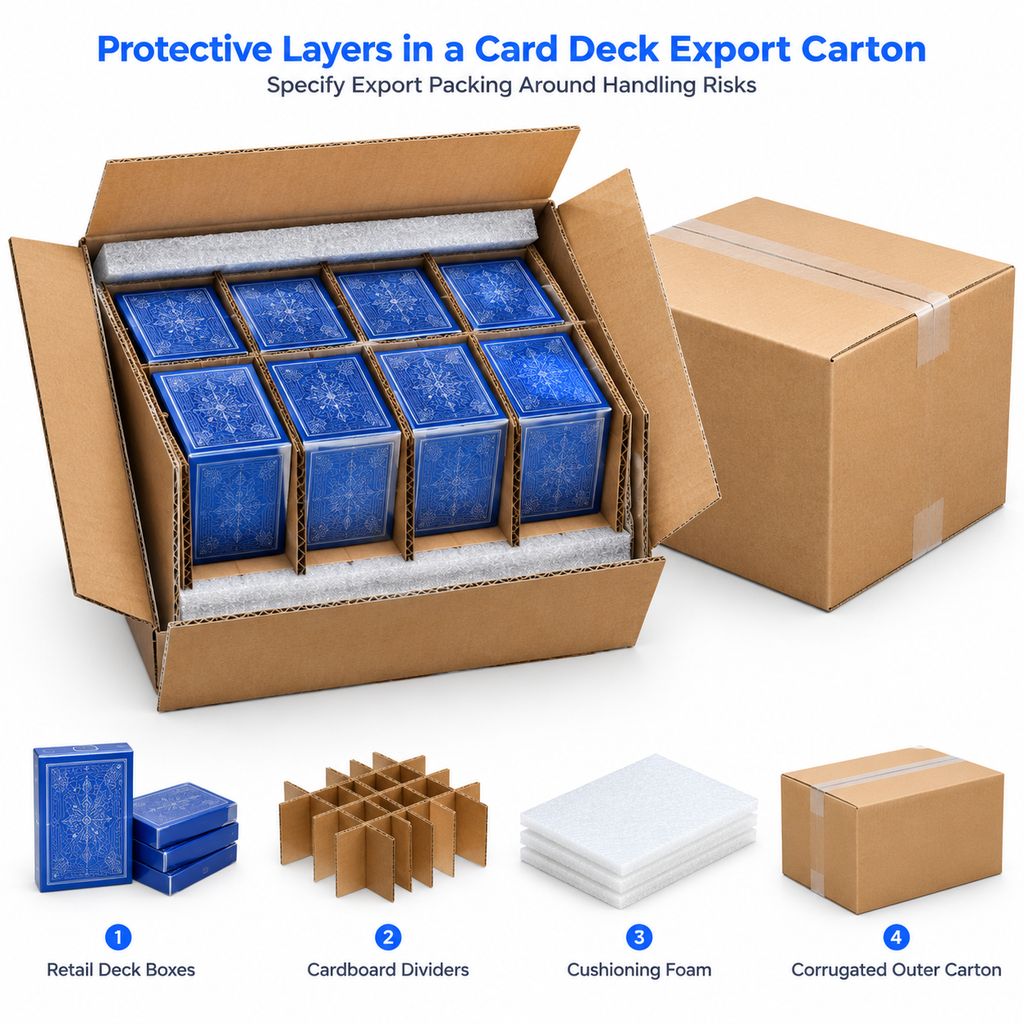
Effective card deck export packing controls movement, compression, abrasion, and moisture exposure. Specify protection for the actual route and handling conditions.
- Deck protection: Agree on wrapping or bagging where needed to limit scuffing and keep components together.
- Internal arrangement: Use a repeatable layout, suitable dividers, and void fill to prevent shifting without crushing retail boxes.
- Carton strength: Select corrugated construction for the packed weight, stacking load, humidity exposure, and handling method.
- Moisture precautions: Discuss liners and appropriately specified desiccants where needed. Pack dry goods; wrapping does not eliminate condensation risk.
- Sealing and labels: Agree on closure, carton numbering, SKU identification, quantities, and handling marks.
For pallets, confirm pallet footprint, loaded height, permitted overhang, load restraint, and warehouse acceptance rules. Solid-wood packaging may require treatment and marking under ISPM 15 requirements published by the IPPC; confirm destination applicability.
Choose the retail presentation separately using the comparison of custom card packaging options, then validate its transport protection.
Match Deck Formats to Transport Packing
Different deck configurations create different packing priorities. This product-format table identifies planning considerations; final carton capacity requires a physical packing trial.
| Deck configuration | Transport concern | Packing detail to confirm |
|---|---|---|
| Playing cards in tuck boxes | Corner crushing and box abrasion | Snug arrangement and separation where needed |
| Game cards with rulebooks or components | Movement and uneven pressure | Internal support and complete-set checks |
| Tarot or oracle decks in rigid boxes | Higher volume and cosmetic damage | Surface protection and measured packed volume |
| Flash cards in larger retail packs | Broad panels and potentially heavy cartons | Panel support and manageable carton weight |
Confirm card count and construction before estimating packing density. The custom game card specification guide explains production choices that affect the finished set.
Calculate Carton Volume and Chargeable Weight
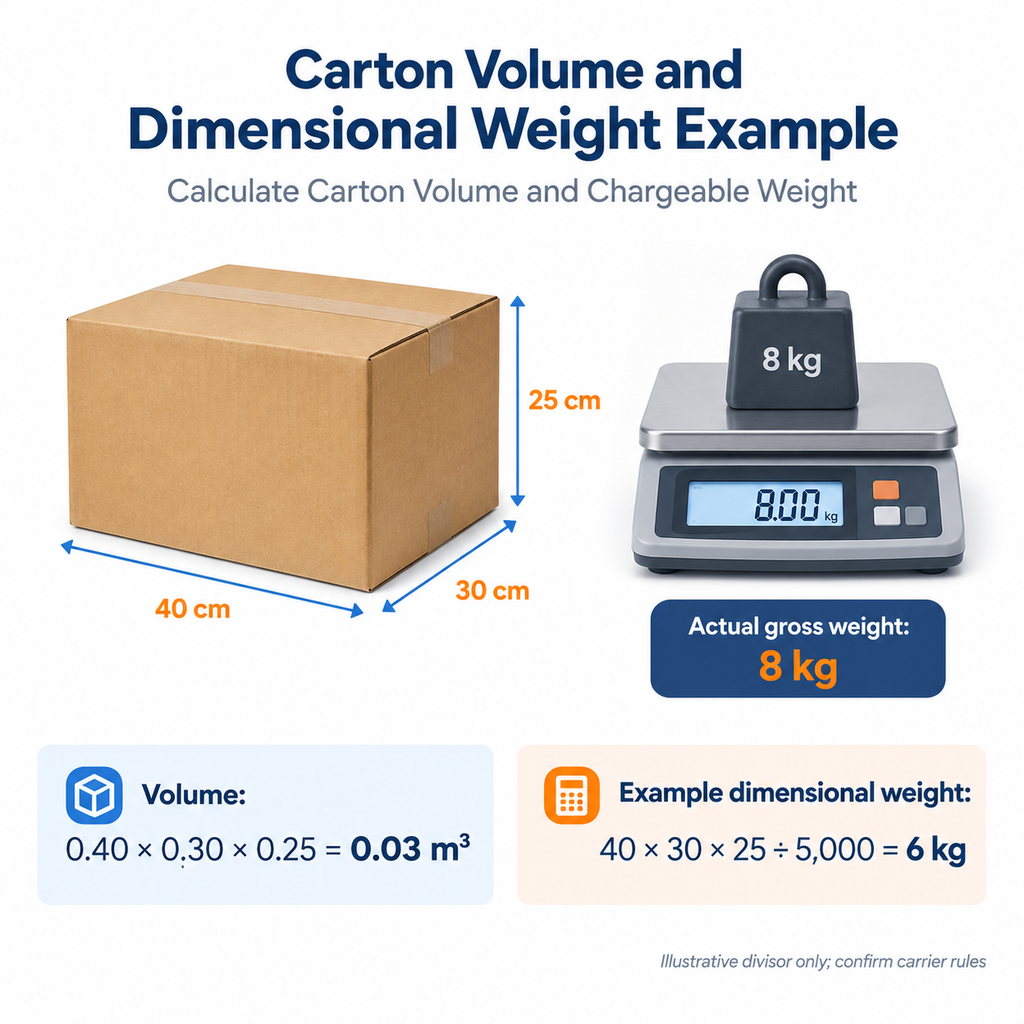
Use measured external carton dimensions and actual packed weight. Product dimensions alone cannot establish shipping charges.
Illustrative example: One carton measures 40 × 30 × 25 cm and weighs 8 kg gross. Its volume is 0.40 × 0.30 × 0.25 = 0.03 cubic meters. Twenty identical cartons total 0.60 cubic meters and 160 kg gross, before palletization.
If a quoted service uses a dimensional divisor of 5,000 cm³/kg, that carton’s dimensional weight is 40 × 30 × 25 ÷ 5,000 = 6 kg. Its actual weight is higher. A service using 6,000 produces a different result. These divisors are examples, not universal carrier rules.
Ask whether billing is calculated per package or across the shipment, how measurements are rounded, and whether minimum or oversized-package charges apply. Sea freight consolidation commonly uses weight-or-measure rules and minimum charges; obtain the forwarder’s exact basis.
When shipping custom card decks in rigid boxes, reducing unused space may help. Any carton redesign should preserve cushioning and stacking strength.
Compare Courier, Air Freight, and Sea Freight
Choose the service around shipment size, required arrival date, receiving capability, and total cost.
| Option | Typical planning fit | Main trade-off | Confirm in writing |
|---|---|---|---|
| Express courier | Samples or small urgent shipments | Convenient delivery; weight and size charges can be significant | Service area, duties, brokerage, and surcharges |
| Air freight | Time-sensitive commercial shipments | Shorter main transit than ocean routes; airport handling adds cost | Collection, clearance, terminal fees, and final delivery |
| Sea freight, LCL | Orders sharing container space | Flexible volume; consolidation and destination minimums affect cost | Origin and destination charges, handling, and release procedures |
| Sea freight, FCL | Orders suited to a dedicated container | Container utilization matters; inland handling needs planning | Loading, unloading, free time, and container-related charges |
LCL means less-than-container load; FCL means full-container load. Compare complete quotations rather than assuming either is cheaper. A split shipment can send launch stock by air and the balance by sea, but adds handling and documentation. Quoted transit time is only one part of the schedule.
Clarify Incoterms and Destination Costs
Specify the Incoterms rule, named place or port, and edition in the order. The rule determines important responsibilities; it does not replace a detailed freight quotation.
- FCA: The seller delivers to the buyer’s nominated carrier at the agreed place and handles export clearance.
- FOB: Delivery and risk transfer occur when goods are on board the vessel at the named shipment port. It applies to sea or inland waterway transport; FCA is generally more suitable for containerized handovers before vessel loading.
- DAP: The seller arranges carriage to the named destination, ready for unloading. The buyer handles import clearance and applicable import duties and taxes.
- DDP: The seller takes responsibility for import clearance and applicable import duties and taxes. Confirm that the proposed arrangement is workable in the destination country.
Refer to the ICC’s official Incoterms guidance. Incoterms do not determine product ownership or payment terms.
For shipping custom card decks, budget goods, export packing, origin handling, freight, insurance where arranged, destination handling, brokerage, duties, nonrecoverable taxes, and final delivery. Clarify unloading, storage, inspection, and delivery appointment charges. Cargo insurance is separate from a carrier’s limited liability.
Approve Samples, Production, and Dispatch in Order
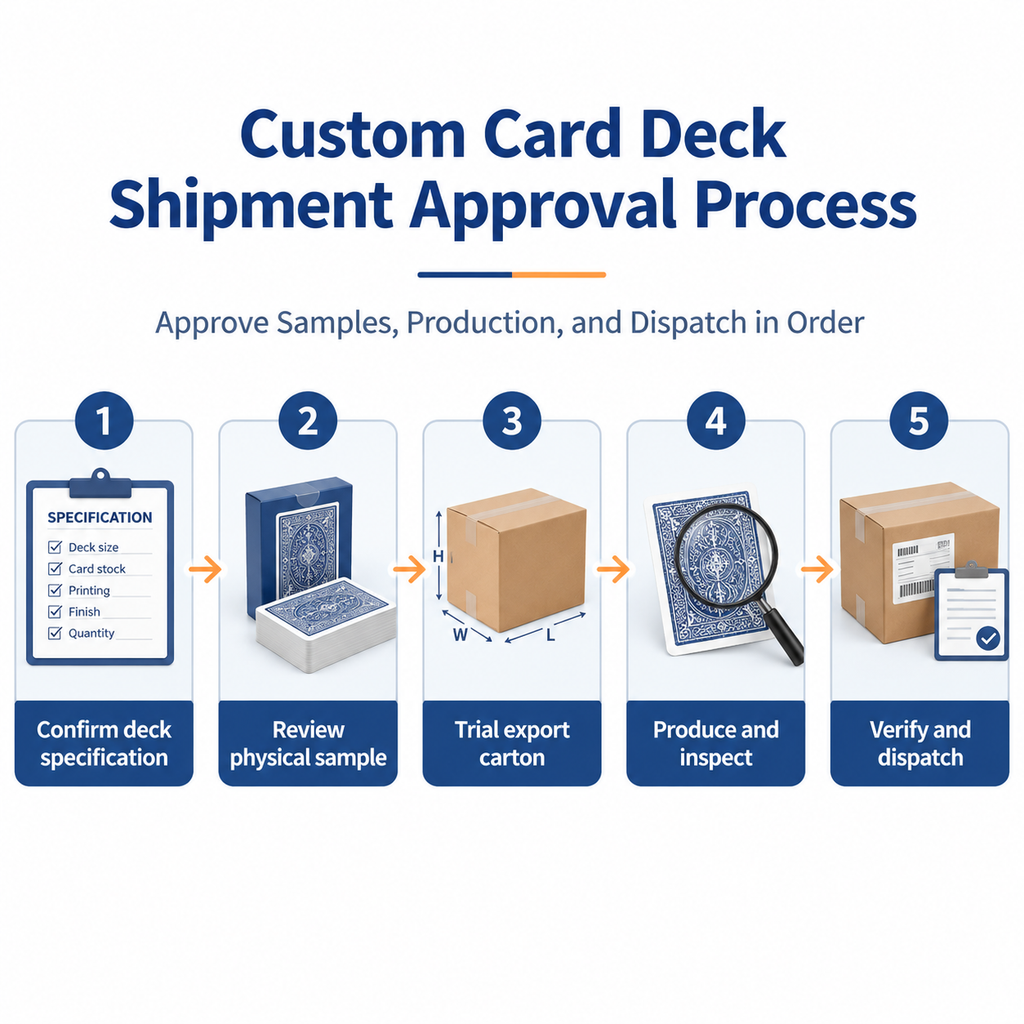
Approve the packing method before bulk dispatch, with enough time to correct problems.
- Freeze the deck specification. Confirm size, card count, material, finish, components, and retail packaging.
- Review a representative sample. Check fit, handling, weight, and box protection. An artwork proof cannot validate transport packing; compare physical samples and artwork proofs.
- Trial the export carton. Confirm layout, deck quantity, external dimensions, gross weight, and any agreed transport testing.
- Release production. Set inspection criteria for print quality, cutting, collation, finishing, assembly, and packing.
- Verify dispatch readiness. Reconcile quantities, carton marks, packing lists, measurements, and booking details. Retain packing photographs and inspection records.
Production MOQ and freight efficiency are different questions. A smaller order may be manufacturable while carrying higher shipping cost per deck. Use the card printing MOQ planning guide to balance inventory exposure against order economics.
Production lead time begins from the agreed approval milestone; freight planning must also allow for inspection, booking, customs, and final delivery.
Prepare Documents and Receiving Instructions
Consistent shipment documents help the broker clear goods and the warehouse receive them correctly.
- Commercial invoice: Accurate goods description, quantities, values, currency, parties, origin, and agreed delivery term.
- Packing list: Carton numbers, SKU quantities, dimensions, weights, and pallet details where applicable.
- Transport document: Bill of lading, sea waybill, air waybill, or courier record as appropriate.
- Destination requirements: Broker-confirmed tariff classification, importer details, and any applicable origin, product, or packaging documentation.
Do not assume every card deck uses the same tariff classification: game sets, printed educational materials, and plastic cards can require different analysis. Confirm with the destination broker.
Provide warehouse booking rules before dispatch. On arrival, count handling units, photograph visible damage, and record exceptions promptly according to the carrier and insurer’s claim procedures.
Key Takeaways for a Comparable Freight Quote
A usable freight brief contains the same core facts for every provider:
- Deck specification, total quantity, and decks per carton.
- Carton count, external measurements, gross weight, and pallet details.
- Collection location, destination postal code, receiving restrictions, and required arrival date.
- Incoterms rule, named place, customs responsibilities, and insurance request.
- Itemized inclusions, exclusions, quote validity, and estimated schedule.
Mark preliminary measurements as estimates and reconfirm charges against the finished shipment.
Conclusion: Approve the Shipment Specification Early
Shipping custom card decks works best when protective packing, measured shipment data, freight selection, and delivery responsibilities are approved together. Validate the carton before dispatch, compare complete destination costs, and keep production and transport milestones separate when planning your launch.
FAQ
What information is needed for an accurate card deck shipping quote?
Provide carton count, external carton dimensions, gross weight, collection point, destination postal code, and requested service scope. Include pallet details and receiving restrictions where applicable. Preliminary estimates should be reconfirmed after final packing.
Is air freight or sea freight better for shipping custom card decks?
Air freight generally suits urgent shipments; sea freight can suit larger, less urgent orders. Compare total costs, shipment volume, customs arrangements, and final delivery. Small ocean shipments may attract minimum handling charges that reduce expected savings.
Can stronger retail boxes replace export cartons?
Retail boxes should not be assumed to provide adequate transport protection. Finished decks normally need an agreed outer-carton arrangement, movement control, and protection appropriate to stacking and handling. Validate the complete packed configuration rather than the retail box alone.
Does a door-to-door quote include duties and taxes?
Not necessarily. Door-to-door describes a transport scope, but does not by itself establish who handles import clearance or pays duties and taxes. Confirm the Incoterms rule, named place, importer responsibilities, and written inclusions and exclusions.
Is there a fixed MOQ or lead time for export orders?
No single MOQ or lead time applies to every project. Requirements depend on card construction, customization, packaging, quantity, sampling, and production planning. Shipping schedules also depend on route, service availability, customs clearance, and destination delivery arrangements.
Ready to Start Your Custom Card Project?
Send us your card type, size, material, quantity, finish, and packaging requirements, along with your destination and target arrival date. Our factory team will recommend suitable production and sampling options and prepare a tailored quote with a shipping scope matched to your project.
Keep Reading
Related Articles
Custom Card Printing Cost: How to Compare Factory Quotes
Compare card printing quotations using the same deck specifications, packaging, quality requirements, and shipping scope. Learn how to separate unit prices, setup charges, and landed costs before choosing a factory.
Shipping Custom Cards from China: A B2B Planning Guide
Plan your card shipment around packed dimensions, freight options, export protection, shipping terms, and destination charges. This guide explains how to connect factory production with a realistic delivery budget and receiving plan.

Card Printing Quality Control: A Bulk Order Checklist
Use this practical bulk-order checklist to define acceptance criteria, inspect printed cards and complete decks, and document packaging and pre-shipment checks.
Fast Quote Support
Ready to Start Your Custom Card Project?
Send us your product type, size, material, quantity, and packaging requirements. Our team will reply within 24 hours with production suggestions, sampling options, and a competitive quote. No setup fees.